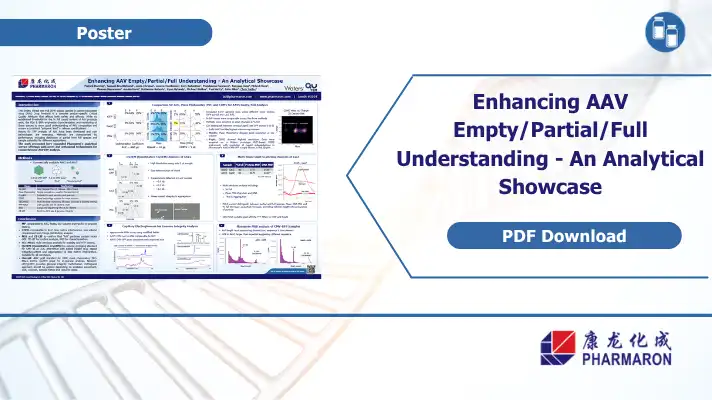
Enhancing AAV Empty/Partial/Full Understanding - An Analytical Showcase
Poster Authors:
Patrick Hoering1, Samuel Brocklehurst1, Luiza Chrojan1, Lauren Tomlinson1, Lucy Ballantine1, Magdalena Pacewicz1, Taeyang Jung2, Mehedi Reza2, Thomas Bausewein2, Anisha Haris3, Katherine Roberts1, Ryan Hylands1, Michael Walker1, Paul Getty1, John Allen1, Chris Sadler1
1Pharmaron, 12 Estuary Banks, Liverpool, L24 8RB, UK
2QuTEM, Gävlegatan 22, 113 30 Stockholm. Sweden
3Waters Corporation, Wilmslow. Cheshire, SK9 4AX
AAV Empty, Partial and Full Capsid Analysis
Understanding the ratio of empty, partial and full (EPF) capsids in adeno-associated virus (AAV) drug products is a critical quality attribute (CQA) that affects both safety and efficacy. AAV EPF analysis helps manufacturers demonstrate good control over product composition and meet the characterization expectations set by the FDA and EMA.
In this poster presented at the American Society of Gene & Cell Therapy (ASGCT) 2026 Annual Meeting, Pharmaron showcases an expanded analytical toolkit for comprehensive AAV EPF analysis. The work compares established and emerging technologies across AAV2 and AAV5 serotypes to help gene therapy developers select the right methods for their program needs.
Capabilities
Why AAV EPF Analysis Matters
Only full capsids carry the therapeutic transgene. Empty capsids deliver no payload but can still trigger an immune response. Partial capsids contain incomplete genetic material that may affect dose consistency. Regulators expect developers to characterize and monitor all three populations throughout clinical development to ensure a consistent antigenic load in release specifications.
No single analytical method captures every attribute of interest. Techniques differ in resolution, sample volume requirements, sensitivity to matrix effects and ability to distinguish partial from full species. Choosing the right combination depends on where a sample sits in the manufacturing process and what level of detail is required.
What This Poster Covers
Pharmaron’s analytical team evaluated seven methods for AAV5 empty/full analysis and broader EPF characterization. This poster compares each technology across the following performance attributes impacting process development and GMP release testing:
- Resolution of empty, partial and full capsids
- Volume requirements and suitability
- Sensitivity to matrix interferences
- Ability to confirm genome integrity and insert size
- Suitability for in-process, release and stability applications
Additionally, this poster introduces data from novel platforms including charge detection mass spectrometry (CDMS) and quantitative cryo-electron microscopy (QuTEM), alongside established methods such as sedimentation velocity analytical ultracentrifugation (SV-AUC) and mass photometry.
Download the poster to see side-by-side method comparisons, representative data across AAV2 and AAV5 serotypes and practical guidance on building an orthogonal analytical strategy for your program.
References:
- FDA: CMC Information for Human Gene Therapy INDs
- Quantification of Empty, Partially Filled and Full AAV Vectors Using Mass Photometry (PMC)
- Analytical characterisationof full, intermediate, and empty AAV capsids
- EMA: Quality, Non-clinical and Clinical Issues for Recombinant AAV Vectors
- Mass photometry as a robust method for characterisingAAV CQAs (PMC)