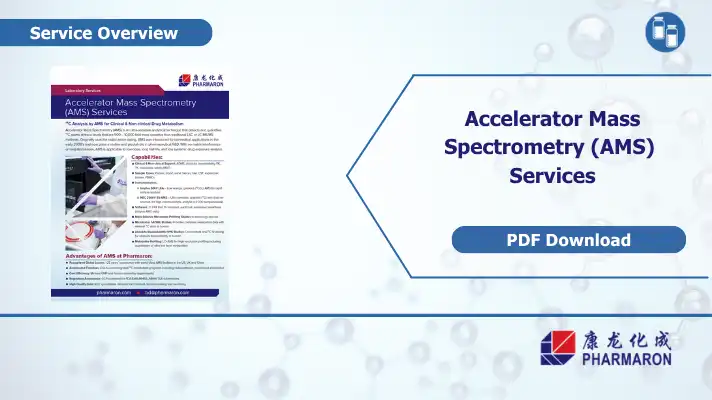
Accelerator Mass Spectrometry (AMS) Analysis

Accelerator Mass Spectrometry (AMS)
Accelerator Mass Spectrometry (AMS) is an ultra sensitive analytical technique that detects and quantifies ¹⁴C atoms at trace levels that are 500 – 10,000 times more sensitive than traditional liquid scintillation counting (LSC) or LC-MS/MS methods. Originally used for radiocarbon dating, AMS was introduced for biomedical applications in the early 2000s and now plays a routine and pivotal role in pharmaceutical R&D. With no matrix interference or ionization issues, AMS is applicable to low-dose, long half-life and low systemic drug exposure analysis.
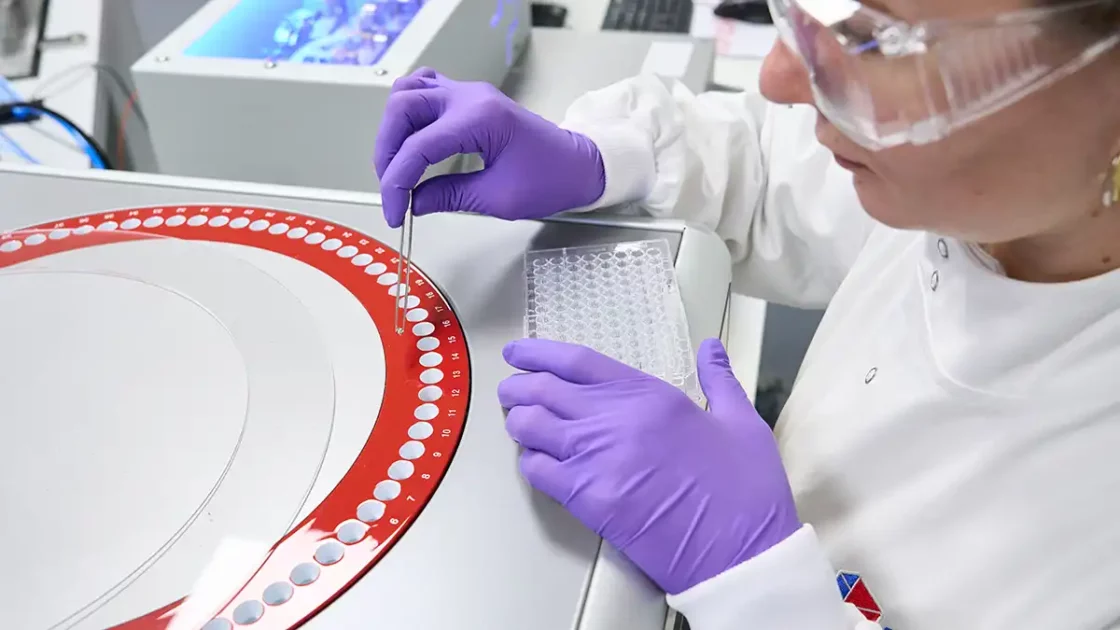
Utilizing AMS technology, a wide range of sample types can be analyzed, including standard matrices (e.g. plasma, whole blood, urine, faeces, etc), and additionally, more unusual matrices (e.g., bile, expired air traps, dialysate, tissue (tumor biopsies), CSF).
14C analysis by AMS for Clinical Metabolism and PK Studies
For over 25 years, Pharmaron has been a recognized leader in developing and utilizing AMS technology for clinical metabolism and PK studies. With world-class AMS facilities in the US, UK and China, our team primarily focuses on employing AMS as an ultra sensitive ¹⁴C analytical platform to support pharmaceutical and biopharmaceutical R&D. The advantages of AMS technology include ultra-sensitive LLOQs (sub-pg equivalents per mL), no matrix interference, and no sample carryover for the graphitization process
Capabilities
Advantages of AMS
- An ultra sensitive technique routinely used in human AME and IVPK clinical sample analysis
- Can support microtracer and full dose (microtracer) clinical study designs, and can be combined with LSC for hybrid sample analysis
- The sensitivity of AMS enables the detection and quantification of low-level metabolites for drugs with complex metabolism profiles
- AMS data are routinely accepted by regulatory authorities for human ADME and absolute bioavailability studies.

Standard Clinical Designs
- Mass balance and total 14C-quantification (total radioactivity) by AMS
- LC+AMS with online high-resolution mass spectrometry
- Absolute bioavailability IVPK / IVMT Studies: Concomitant therapeutic extravascular/14C IV dosing for absolute bioavailability
- 14C dose solution analysis for low specific activity 14C dose preparations

Capabilities
- Clinical & Non-clinical Support: ADME, absolute bioavailability, PK, metabolite safety (MIST)
- Sample Types: Plasma, blood, urine, faeces, bile, CSF, expired air, tissues, PBMCs
- Instrumentation
- Ionplus50kV LEA – low energy, gaseous (14CO2) AMS for rapid sample analysis
- NEC 250kV SS-AMS – ultra-sensitive, graphite (14C) with dual ion sources, for high volume sample analysis (>2,000 samples/week)
- Software: 21 CFR Part 11 compliant, audit trail, automated workflows (Ionplus LEA only)

Benefits of AMS with Pharmaron
- Global Capabilities Dedicated labs in the US, UK and China providing global access to world-class AMS expertise
- Accelerated Timelines: End-to-end integrated 14C metabolism programs including radiosynthesis, non-clinical and clinical support
- Cost Efficiency: Minimal GMP and human dosimetry requirements
- Regulatory Acceptance: regulatory compliant for FDA/EMA/MHRA/JMHW/TSA submissions
- High Quality Data: Rich, quantitative datasets for confident decision-making and de-risking