ADC in vitro characterization case study on Dato-DXd
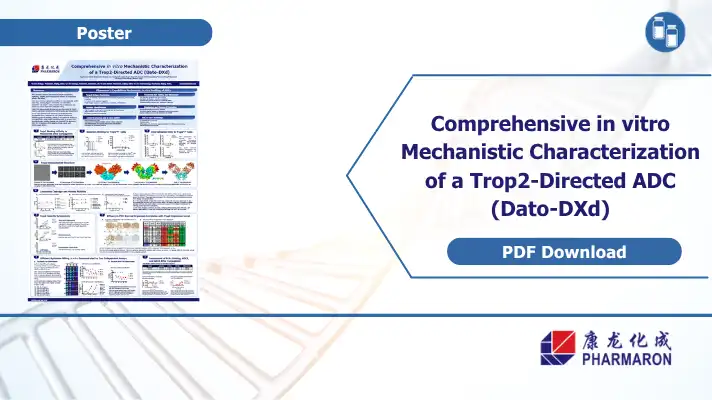
Poster Authors:
Pengfei Gao, Marta Westwood, Xinghan Liu, Yasong Cui, Yuhui Wang, Fang He, Chunyan Han, Cheng Zhang, Xiaoxue Wang, Mandy Xu, Tan Pang, Chong Wang & Mengya Tong
Pharmaron Hoddesdon, UK & Pharmaron, Beijing, China
Comprehensive ADC in vitro Characterization of the Trop2-Directed ADC Dato-DXd
Thorough ADC in vitro characterization sets the stage for successful ADC discovery and development. Our teams are equipped to understand each component’s contribution to binding, structure, stability and payload release to ensure progression of the most robust ADC candidates.
ADC in vitro Services Demonstrated in the Case Study
In our case study, we utilize the Trop2-binding ADC Dato-DXd as an example of how Pharmaron integrates biophysics, biology, structural biology and bioanalysis to reveal ADC mechanism and behavior. Our clients utilize in vitro assays to avoid advancing compounds with suboptimal stability, poor intracellular delivery, or unchecked Fc-related immunotoxicities.
The following attributes of Dato-DXd were characterized:
- Target engagement and internalization
- Linker stability and payload release
- Efficacy via 2D cytotoxicity assays, PDX-derived organoids and bystander killing assays
- Fc-effector binding and function
- Structure of the antibody-Trop2 complex
Capabilities
Why Choose Pharmaron for ADC in vitro characterization Services?
- Eliminating critical data blind spots: Integrated, mechanism-driven profiling connecting all aspects to provide clear mechanistic understanding of the compound
- Seamless integrated platform: End-to-end ADC platform: In vitro ADC testing is a part of our fully integrated ADC platform covering antibody discovery, linker-payload design, preclinical testing, manufacturing, and clinical development
- Stronger IVIVE alignment across your studies: Translationally relevant models including patient-derived systems, toxicology and developability studies to de-risk late-stage development