Accelerator Mass Spectrometry for Modern Phase 1 Clinical Studies
Poster Authors:
Adrian Pereira , Iuliana Stanciu, Doru Pacesila and Marie Croft
1 Pharmaron, Hoddesdon, UK
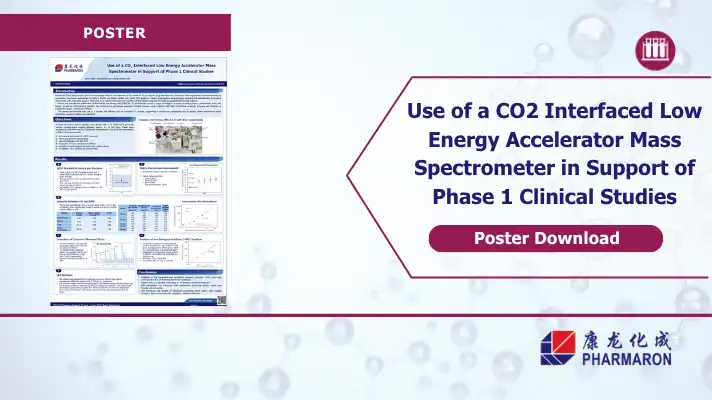
Download Poster: Use of a CO₂-Interfaced Low Energy Accelerator Mass Spectrometer in Support of Phase 1 Clinical Studies
Accelerator Mass Spectrometry (AMS) is increasingly being used to support drug development programmes requiring highly sensitive quantification of 14C-labelled compounds. As microtracer approaches become more widely adopted in human ADME (hAME) and human absolute bioavailability (hABA) studies, the need for sensitive, efficient and regulatory-compliant analytical technologies continues to grow. This poster describes the qualification of the Ionplus Low Energy AMS (LEA) platform for low-level 14C analysis across a range of biological and non-biological matrices, demonstrating its suitability for supporting Phase 1 clinical studies.
Key Takeaways:
Ionplus Low Energy AMS platform was qualified for routine analysis of low-level 14C in plasma, whole blood, urine, faeces and non-biological samples. Validation exercises showed acceptable performance for accuracy, precision, linearity, carryover and lower limit of quantification. Automated CO₂ interface also allowed for rapid analysis of samples and streamlined workflow. Overall, these findings support implementation of LEA into contemporary 14C-enabled clinical development programs.
Capabilities
In order to support the regulatory requirements of Phase 1 clinical development and improve understanding drug disposition, microtracer approaches are being use with greater frequency. These studies require highly sensitive analytical techniques capable of measuring extremely low levels of 14C. Traditional AMS methodologies often rely on graphitisation workflows that can be labour-intensive. Newer low-energy AMS platforms offer a more streamlined alternative while maintaining the sensitivity required for clinical applications.
Qualification of a Modern Low-Energy AMS Platform:
To assess platform performance, a range of human matrices were spiked with 14C standards covering concentrations from approximately 0.2 to 500 dpm. Performance characteristics evaluated included:
- Accuracy and precision
- Matrix background assessments
- Linearity against liquid scintillation counting (LSC)
- Carryover and memory effects
- Analysis of non-biological samples
- Software validation and compliance considerations
The study compared AMS and LSC performance where concentrations were within the quantifiable range of both techniques.
Key Results
The qualification study demonstrated that the CO₂-interfaced Low Energy AMS (LEA) platform delivers accurate, precise and reliable low-level 14C quantification across a range of biological and non-biological matrices, with strong agreement to conventional liquid scintillation counting methods. The system was successfully validated for regulated bioanalytical applications and showed excellent performance, reproducibility and broad matrix applicability. By combining exceptional sensitivity with rapid sample processing and regulatory-compliant workflows, LEA provides an efficient solution for supporting human ADME, absolute bioavailability, microtracer and other 14C-enabled clinical studies.
Why Pharmaron?
Pharmaron offers integrated AMS and bioanalytical capabilities to support the full lifecycle of radiolabelled drug development programmes. Our expertise spans clinical and non-clinical ADME studies, microtracer investigations, mass balance studies, metabolite profiling and regulatory-compliant bioanalysis. By combining advanced AMS technologies with scientific and operational expertise, we help accelerate the generation of critical clinical development data.
