An Alternate Approach to AAV Purification
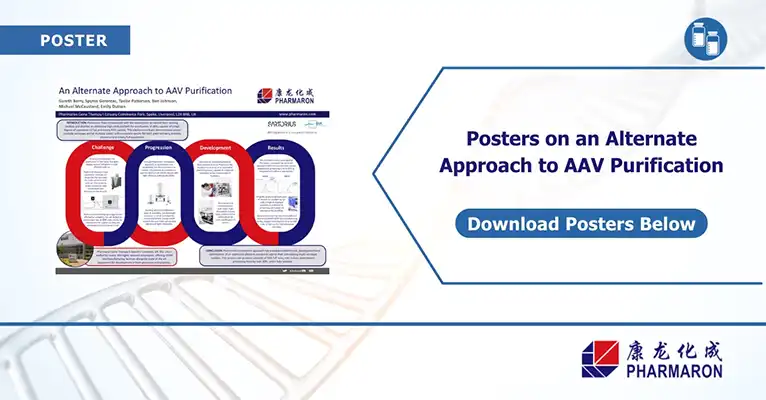
Poster Authors:
Gareth Berry, Spyros Gerontas, Taelor Patterson, Ben Johnson, Michael McCausland, Emily Dutton
Pharmaron Gene Therapy l Estuary Commerce Park, Speke, Liverpool, L24 8RB, UK
AAV Purification: Downstream Process Decisions That Determine Yield and Quality
AAV purification is at the center of every gene therapy program. A lot of teams treat purification like a black box. That is risky because each step affects the next step.
- initial capture
- concentration
- buffer exchange
- polishing
Small shifts in the process can result in large changes in recovery, impurity levels, and how well the process scales.
Full / empty capsid separation is where many workflows have problems. Empty capsids dilute the effective dose. They also add friction to regulatory filings. Getting better separation usually comes with hard trade-offs.
- higher purity, lower yield
- better separation, more complexity
- works at 10 L, breaks at 200 L
Capabilities
Pharmaron partnered with BIA Separations to fill a gap in the toolbox. The goal was simple. Build a platform that improves full and empty capsid separation without crushing yield. Purification results only matter if the analytics connect back to quality attributes. You need methods that answer clear questions.
- how much empty capsid is left
- residual host cell DNA
- aggregates forming during concentration
Good analytics do more than report purity. They show whether the process can be controlled. They also give you stronger evidence for regulators and for scale-up decisions.
Before you lock in an AAV purification strategy, ask these questions:
- Can this process handle the impurity profile from my upstream system?
- What happens to yield and purity when I scale by 10x or 50x?
- Do I have analytics that measure what actually matters for my product?