Anti-PEG Immunogenicity Assays for LNPs and Biologics
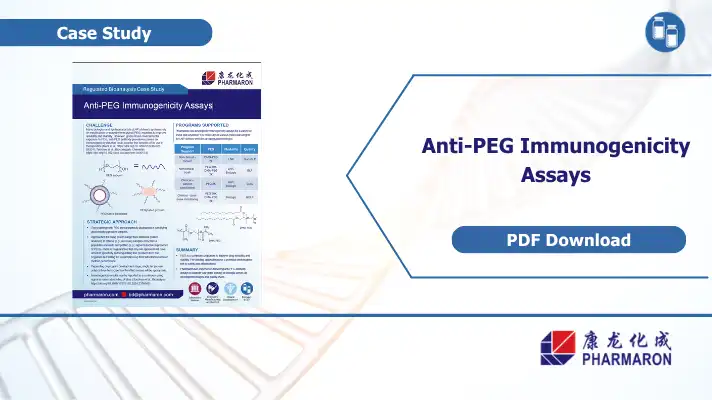
Anti-PEG Immunogenicity Testing
Anti-PEG immunogenicity testing is difficult since most people already carry anti-PEG antibodies from everyday exposure, requiring the separation of true positives from true negatives. Pharmaron has developed anti-PEG immunogenicity assays for linear and acylated polyethylene glycol (PEG) molecules across a range of molecular weights, supporting LNP delivery vehicles and PEGylated biologics.
This Pharmaron case study sets out the assay strategy, the available sample classification approaches, and how tier structure changes with development stage.
What is anti-PEG immunogenicity?
Many biologics and LNP delivery systems use PEG moieties to improve solubility and stability. However, the prevalence of anti-PEG antibodies poses an immunogenicity risk capable of countering the benefit PEG provides. Pre-existing antibodies can affect the safety and effectiveness of a therapeutic, which is why anti-PEG screening now features in many development programs.
Why is anti-PEG assay design difficult?
The central challenge is identifying and excluding positive samples when the background positive rate is high. Available approaches span statistical treatments such as outlier analysis, rational rules applied to the population plus competition formats that look for signal reduction in the presence of free PEG. No single approach guarantees absolute specificity in separating true positives from true negatives. What matters is stating the assumptions early on, because those assumptions govern what can be claimed about method performance. This case study works through each option.
Capabilities
How many assay tiers does a program need?
Tier structure follows the development stage. A single-tier screen may be sufficient early, while a three-tier screen, confirm and titer structure suits later work. Results may also be reported as a continuum using signal to noise ratios in place of titers, an approach gaining support as the wider immunogenicity field revisits automatic three tier testing. The case study maps the choices to stage.
Which programs has Pharmaron supported?
Pharmaron has delivered anti-PEG antibody assays from nonclinical rodent and non-human primate work through to clinical patient enrollment and post-dose monitoring, spanning non-GLP, GLP, CLIA, and GCLP quality levels. Assays have covered several PEG types and molecular weights across both LNP and biologic modalities. The case study gives the full program table with the PEG, modality, and quality level for each.
Key Takeaways
- Widespread environmental PEG exposure means pre-existing anti-PEG antibodies are common before dosing begins.
- Sample classification, rather than detection, is the hard part of anti-PEG assay design.
- Stating cut-point assumptions up front governs what can be claimed about method performance.
- Pharmaron delivers anti-PEG assays across non-GLP, GLP, CLIA and GCLP quality levels for LNPs and biologics.
What is in the case study
The case study gives the full program support table with PEG type, molecular weight, modality and quality level for each study, the sample classification approaches with their trade-offs plus guidance on tier structure and signal to noise reporting. Complete the form to download it.

Learn about Pharmaron’s anti-PEG immunogenicity assay strategy and programmes supported.
References
- Mora JR, White JT, DeWall SL. Immunogenicity Risk Assessment for PEGylated Therapeutics. AAPS J. 2020;22(2):35. DOI 10.1208/s12248-020-0420-0.
- Tenchov R, Sasso JM, Zhou QA. PEGylated Lipid Nanoparticle Formulations: Immunological Safety and Efficiency Perspective. Bioconjug Chem. 2023;34(6):941-960. PMID 37162501.
- Goodman J, et al. Re-thinking the current paradigm for clinical immunogenicity assessment: an update from the discussion in the European Bioanalysis Forum. Bioanalysis. 2024;16(17-18):905-913. PMID 39119660. https://pubmed.ncbi.nlm.nih.gov/39119660/
- FDA. Immunogenicity Testing of Therapeutic Protein Products: Developing and Validating Assays for Anti-Drug Antibody Detection (Final, February 2019).
- FDA. M10 Bioanalytical Method Validation and Study Sample Analysis (Final, November 2022).