Biodistribution and Shedding Study Design for Gene Therapy
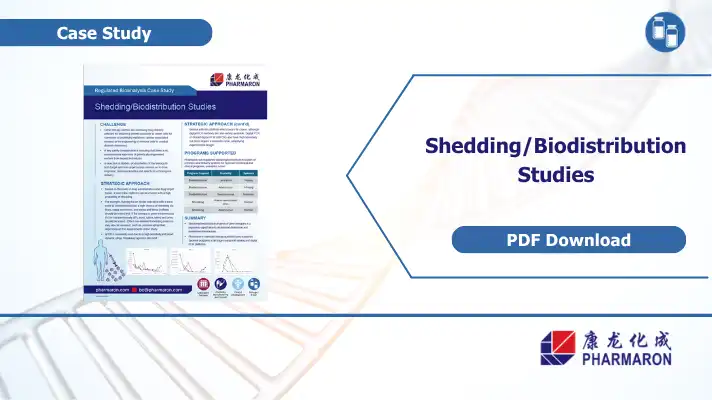
The Importance of Biodistribution and Shedding Study Design
For gene therapy developers, understanding where a vector goes after administration and whether it can be detected outside the patient are essential parts of building a regulatory package. Biodistribution and shedding studies provide the data needed to answer those questions, but the success of a study often depends on decisions made long before samples reach the laboratory.
Two choices have an especially large impact: selecting the right biological matrices and choosing the most appropriate PCR platform. Make the right choices early and the study can generate meaningful data efficiently. Get them wrong and timelines, budgets, and regulatory interactions can become more complicated than they need to be.
Pharmaron has supported biodistribution and shedding programs across both nonclinical and clinical development, working with a range of commonly used viral vectors. In this case study, we share practical considerations for study design, discuss the strengths and limitations of different PCR technologies, and highlight the types of programs our team has supported.
Download the case study to learn more.
Why Are Biodistribution and Shedding Studies Important?
Whether a gene therapy uses an AAV vector to deliver a therapeutic gene or a lentiviral system to modify cells, sponsors need to understand how that therapy behaves beyond its intended target.
Biodistribution studies help determine where vector material can be found throughout the body. In addition to confirming delivery to the target tissue, they can reveal distribution to non-target organs and support a broader understanding of pharmacokinetics, tissue exposure, and transgene expression.
Shedding studies address a different question: can vector material be released from a treated individual? These assessments are required to better understand the potential for environmental impact and any associated safety considerations.
Together, these studies provide critical information to support development decisions and regulatory submissions.
Capabilities
Selecting the Right Matrices
One of the most common questions during study planning is which samples should be collected.
The answer starts with the route of administration and the intended target tissue. These factors help identify the biological fluids and tissues most likely to contain detectable vector material. Rather than taking a standardized approach, study designs should focus on collecting samples that are most likely to generate meaningful data.
This case study outlines different matrices for common administration routes and explains the rationale behind those selections.
Choosing Between qPCR and dPCR
The analytical platform is another important consideration.
qPCR remains the most widely used approach for biodistribution and shedding studies because it offers excellent sensitivity, a broad dynamic range, and a long history of regulatory acceptance.
Digital PCR technologies, including ddPCR, have become increasingly popular because they provide highly sensitive detection without relying on standard curves. For some applications, this can simplify method setup and data interpretation.
Neither platform is universally better than the other. The optimal choice depends on the goals of the study, the characteristics of the assay, and regulatory expectations. Because Pharmaron supports qPCR, dPCR, and ddPCR workflows, sponsors can select the approach that best fits their program rather than adapting the study to fit a single technology.
Experience Across Development Stages
Pharmaron’s molecular biology teams have supported biodistribution and shedding studies from early nonclinical research through clinical development. Our experience spans multiple viral vector platforms and a wide variety of therapeutic programs, helping sponsors generate the data needed to advance development with confidence.
The case study includes examples of vector systems and development stages supported by our team.
Key Takeaways
- Biodistribution and shedding studies are a standard expectation for many gene therapy programs.
- Matrix selection should be driven by the route of administration and target tissue.
- qPCR provides sensitivity and regulatory familiarity, while dPCR technologies offer highly sensitive quantification without standard curves.
- Study design decisions made early can have a significant impact on the quality and usefulness of the resulting data.
- Pharmaron supports biodistribution and shedding studies across both nonclinical and clinical development using multiple PCR platforms.
What’s Included in the Case Study?
Download the full case study to explore:
- Matrix recommendations for common routes of administration
- A comparison of qPCR and dPCR technologies
- Examples of supported viral vector platforms
- Experience across nonclinical and clinical development programs

Learn about Pharmaron’s matrix selection guidance and PCR platform comparison for shedding studies.
References
- FDA. Long Term Follow-Up After Administration of Human Gene Therapy Products (Guidance for Industry, Final, January 2020).
- FDA. Preclinical Assessment of Investigational Cellular and Gene Therapy Products (Guidance for Industry).
- Brandon EFA, et al. Effect of administration route on the biodistribution and shedding of replication-deficient AAV2: a qualitative modelling approach. Curr Gene Ther. 2010;10(2):91-106. PMID 20222862.
- FDA. M10 Bioanalytical Method Validation and Study Sample Analysis (Final, November 2022).