iPSC-Derived Cerebral Organoids for CNS Drug Discovery
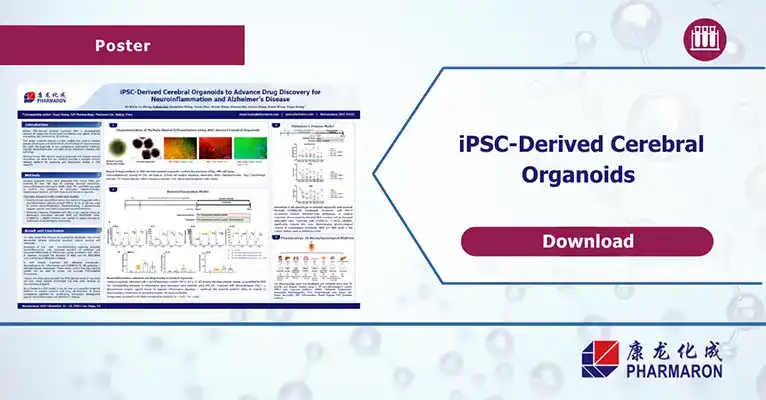
Poster Authors:
Bo Wang, Lu Zhang, Yufang Yan, Hongchun Zhang, Yuwei Zhao, Wenqi Zhang, Xiaopan Nie, Liyuan Zhang, Ruixiu Wang, Jingqi Huang
Pharmaron Inc, Beijing, China
Scalable, Human-Relevant Brain Organoids for Screening and Mechanistic Studies in CNS Research
This poster was presented at the SFN Neuroscience conference 2025.
Human iPSC-derived cerebral organoids provide a physiologically relevant 3D model that successfully recapitulates key aspects of human brain architecture and cellular diversity. These advanced “disease-in-a-dish” models overcome critical limitations of traditional 2D cultures and animal models, offering a powerful platform to accelerate therapeutic development.
Our poster presents our work in developing and validating cerebral organoid models for two significant translational applications:
- Cytokine-induced neuroinflammation
- Aβ42-driven Alzheimer’s disease pathology
The data demonstrates how these brain organoids not only reveal complex disease phenotypes but also show clear pharmacological responsiveness to reference compounds.
Capabilities
Key Features of Our Cerebral Organoid Platform
Pharmaron’s validated cerebral organoid platform offers a robust and predictive system for evaluating CNS-targeted therapeutics. Our approach provides direct access to our scientific team, ensuring your study is designed to meet specific research objectives efficiently and cost-effectively.
- Physiologically Relevant 3D Models: Our organoids are cultured for over 100 days to promote neuronal maturation, containing abundant mature neurons, astrocytes, and other key CNS cell types that mimic in vivo brain tissue. We can also directly differentiate organoid into specific regions of the brain to model various neuron-dominated diseases and supports co-culture systems with immune cells, such as microglia.
- Scalable Platform for CNS Drug Screening: We have established a robust and scalable process for generating cerebral organoids, enabling high-throughput screening for neuroinflammation and Alzheimer’s disease pathology.
- Demonstrated Therapeutic Efficacy: Our models show that treatment with reference compounds, such as dexamethasone and the BACE1 inhibitor LY2886721, effectively reverses induced neuroinflammatory and amyloidogenic phenotypes.
Download our scientific poster to gain insights into our brain organoids platform and how we can support your CNS therapeutic development.