Time-Dependent Inhibition of CYP3A4/5 in Hepatocytes
Poster Authors:
1 Pharmaron, Hoddesdon, UK
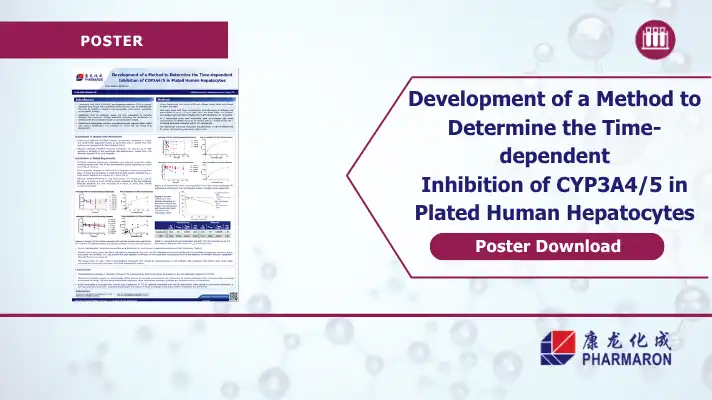
Poster: Time-Dependent Inhibition of CYP3A4/5 in Hepatocytes
Predicting drug–drug interactions (DDIs) mediated by time-dependent inhibition (TDI) of CYP3A4 requires an assay capable of accurately detecting and quantifying TDI. Here we present a hepatocyte TDI assay that demonstrates improved physiologic relevance and sensitivity over conventional microsomal assays for slowly metabolised compounds.
Top Points: Hepatocyte-Based Assessment of CYP3A4/5 TDI:
- Directly utilizes hepatocytes, the most physiologically relevant in vitro system available
- Allows for enhanced sensitivity in the detection of TDI
- Facilitates prediction of clinical outcome that is similar to or better than current predictions
TDI assays are routinely performed in human liver microsomes (HLM), which can artificially alter inhibitor behaviour due to:
- Limitations of permeability and active transporters
- Rapid depletion of co-factors
- Need for short incubation times with slow turnover drugs
TDI assays conducted in HLM can underestimate or overestimate clinical risk.
We demonstrate that a plated hepatocyte assay overcomes these limitations by allowing for:
- Long-term pre-incubations up to 14 hours
- Maintenance of enzymatic function during assay
- Improved detection of slow and/or mechanism-based inhibitors
Capabilities
We established reliable determination of KI and kinact parameters, facilitating greater confidence in DDI predictions.
- Erythromycin exhibited similar inactivation parameters in both hepatocytes and microsomes
- Slower, but more potent inactivation of diltiazem in hepatocytes highlights how ADME properties can shift between systems
- TDI assessments were approximately 30-fold more sensitive in hepatocytes
Bottom Line
Employment of plated hepatocytes allows for improved sensitivity and prediction of CYP3A4/5 TDI.
Why Pharmaron?
Pharmaron provides integrated in vitro DMPK solutions to support drug discovery and development, including:
- Advanced hepatocyte and microsome-based assays
- DDI and TDI risk assessment aligned with ICH M12 guidance
- Expertise in complex metabolism and transporter interactions
