Complex Drug-drug Interactions: Predicting the Unexpected
Capabilities
Recorded: February 2023
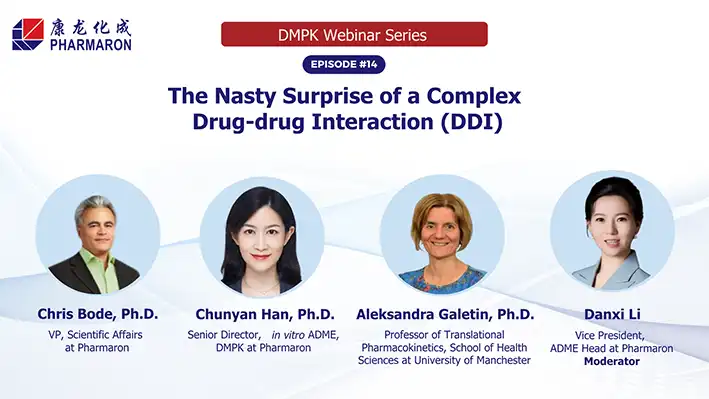
How can scientists assess DDIs involving multiple enzymes, transporters and metabolites?
Complex drug-drug interactions may occur due to multiple mechanisms. One compound may inhibit one enzyme and induce another enzyme, involve transporter interactions, produce an inhibitory metabolite or alter tissue exposure without markedly altering plasma pharmacokinetics.
In this on-demand webinar, Pharmaron and University of Manchester experts discuss how the use of in vitro studies, preclinical models, endogenous biomarkers and PBPK modeling can identify complex DDI risks and inform smarter development decisions.
Complex DDIs often involve multiple interacting mechanisms. PBPK modelling allows us to mechanistically investigate enzyme effects, transporter interactions and tissue exposure together, helping us better understand and predict clinical risk.

Aleksandra Galetin, Ph.D.
Professor of Translational Pharmacokinetics
University of Manchester
Why do complex DDIs matter?
Complex DDIs can include multiple mechanisms occurring simultaneously such as reversible or time-dependent inhibition, induction, enzyme-transporter interplay and metabolite-mediated DDIs.
These mechanisms can overlap, making the clinical outcome challenging to predict based on one assay or measurement. This webinar demonstrates why a combination of experimental and modelling approaches are necessary to understand the full interaction risk.
Key takeaways:
- Not all interactions will be found using standard assays. If a mechanism is metabolism-dependent, or involves inhibitory metabolites then an alternative experimental system may be required.
- Mechanistic models can strengthen DDI predictions. PBPK and mechanistic static models can integrate enzyme, transporter, physiological and clinical data to investigate multiple interacting processes.
- Plasma exposure may not reflect tissue exposure. Transporter modulation can alter drug disposition within an organ without causing a clear change in plasma pharmacokinetics.
- Endogenous biomarkers can support earlier evaluation. Biomarkers such as coproporphyrin I can provide information about transporter function and help guide prospective study design.
- Models should be validated using clinical data. PBPK modelling may be used to prioritise or limit clinical studies, but the model should first be validated with appropriate pharmacokinetic and drug interaction data.
- Age can affect predicted DDI risk. Different assumptions about CYP3A4 development can produce different DDI predictions in paediatric populations.
Five questions explored in the webinar
1. What makes a complex drug-drug interaction?
A complex DDI involves more than one mechanism or biological process. This could include enzyme inhibition and induction, transporter activity, or the formation of an inhibitory metabolite. The webinar explores how these effects can combine to produce unexpected clinical outcomes.
2. Are complex drug interactions predictable before heading into clinical studies?
Many predictable risks can be detected through a combination of in vitro screening, kinetic analyses, static calculations, and PBPK modeling. Although it’s still conceivable that idiosyncratic mechanisms could go undetected, the choice of experimental models will be critical.
3. Why is the repaglinide, gemfibrozil and itraconazole interaction described in the webinar important?
Gemfibrozil alone increased repaglinide exposure eightfold, while its combination with itraconazole increased exposure nineteenfold. The example shows how inhibition of CYP2C8 and CYP3A4 can combine to create a substantially greater effect.
4. How can PBPK modelling support complex DDI assessment?
PBPK models offer a way to integrate both compound-specific details and physiological data, enabling an assessment of enzyme and transporter effects, tissue exposure, dose dependency, dose staggering, and population-specific situations. In this webinar, learn where modelling adds the most value and what evidence is required to gain confidence in a model.
5. Can biomarkers eliminate the need for clinical DDI studies?
Qualified endogenous biomarkers can be used to generate early evidence of transporter inhibition without the need to administer a dedicated probe. They can also be used in conjunction with modelling to predict which clinical studies would be most informative, although they may not obviate the need for clinical assessment in all cases.
What you will learn
- How complex DDIs arise through interactions between CYP enzymes, transporters and metabolites
- Why conventional in vitro testing may not reveal every relevant mechanism
- How static and PBPK models contribute to DDI risk assessment
- Why plasma pharmacokinetics may not capture tissue-level effects
- How endogenous biomarkers can support transporter DDI evaluation
- What must be demonstrated before modelling can inform clinical study decisions
- Why paediatric DDI predictions require careful consideration of enzyme development
On-demand webinar
Learn how coupling experimental and modelling approaches can assist with elucidating unknown mechanisms of interactions, increase confidence in DDI predictions and enable more informed decisions throughout development.
