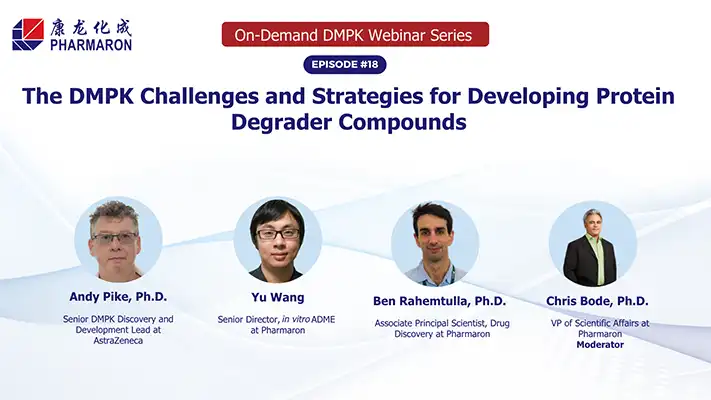
Developing Protein Degraders: DMPK Challenges and Strategies
Capabilities
Recorded: July 2023
How can scientists generate reliable DMPK data for protein degraders with challenging physicochemical properties?
While chemical matter acts as a translational probes, protein degraders may sit outside of traditional small molecule property space. Large size, lipophilicity, poor solubility, high binding and extensive metabolism can impact assay performance, data interpretation, and in vivo properties.
Join our experts from Pharmaron and AstraZeneca to learn how modified ADME assays and medicinal chemistry approaches can help improve data quality and aid structure optimisation. We will discuss how properties such as solubility, logD, protein binding, permeability, metabolism, and oral bioavailability impact protein degraders. Plus, how to assess degrader developability early with integrated ADME workflows.
The principles still apply, but the limits to which we can stretch them have been pushed. The question is: would our conventional in vitro screening approaches necessarily have spotted these orally bioavailable molecules?

Andy Pike, Ph.D.
Senior DMPK Discovery and Development Lead, AstraZeneca
Why do protein degraders need tailored DMPK strategies?
High molecular weight, lipophilicity and molecular flexibility are common traits amongst protein degraders that can lead to challenging behaviour. While most rules of thumb for DMPK still apply, poor solubility, nonspecific binding and assay recovery can compromise standard in vitro assessments. In this webinar, we explore why assay conditions, data interpretation, and medicinal chemistry must be strategically aligned to optimize these compounds.
Key takeaways
- Many traditional ADME assays will require optimization. Poor recoveries, nonspecific binding, and limited assay dynamic range are common with protein degraders. These issues can lead traditional assays to produce unreliable results if not optimized accordingly.
- Compound properties affect assay behavior and in vivo activity. Properties such as molecular weight, lipophilicity, solubility and molecular flexibility can impact permeability, clearance and oral bioavailability.
- Exercise caution when reviewing assay data. Traditional in vitro measurements may not translate well to in vivo findings when assessing degrader-like molecules.
- Use DMPK data to prioritize structure optimisation efforts. By examining compound data like solubility, permeability, metabolic stability, and oral bioavailability, teams can make better choices regarding linker design, lipophilicity, and the overall balance of properties.
- Considerations for metabolites and linker cleavage. Metabolic stability and resulting metabolite profiles as well as PK/PD relationships will become important when evaluating degrader potency.
- Consider DMPK in your medicinal chemistry program. Early stage experimental data can be leveraged alongside medicinal chemistry efforts to identify patterns during compound optimisation.
Five questions explored in the webinar
What makes protein degraders so difficult to measure with standard DMPK assays?
Degraders tend to be high MW, lipophilic, poorly aqueous soluble, high binders with complex metabolism. Some of these attributes influence how they behave biologically and some influence how well our standard assays work.
Why can traditional ADME assays be difficult to use with protein degraders?
Poor recovery, binding to labware or membranes, low solubility and limited assay dynamic range can complicate measurements. The webinar discusses modified approaches for solubility, logD, protein binding, permeability and metabolism.
How can ADME methods be adapted for degrader-like compounds?
Assay conditions and interpretation can be adjusted to account for solubility limits, nonspecific binding and recovery issues, helping teams generate more reliable and actionable data.
How can DMPK data support protein degrader optimisation?
DMPK findings can inform medicinal chemistry decisions around chemical space, linker design, lipophilicity, solubility, permeability, metabolism and overall developability.
Can protein degraders achieve oral bioavailability?
The webinar discusses examples where in vivo performance was better than conventional in vitro measures might suggest. It also explains why prediction remains difficult for individual molecules and needs careful interpretation.
What you will learn
- Understand why protein degraders fall outside traditional small molecule property space
- Recognise how poor solubility, high binding and low recovery can lead to poor in vitro ADME data
- Learn how ADME assays can be tailored for protein degrader programmes
- Gain the confidence to assess solubility, logD, protein binding, permeability and metabolism with protein degraders
- Learn why in vitro data may not always translate to in vivo
- Understand how metabolites, linker cleavage and PK/PD relationships can impact optimisation efforts
- Learn how DMPK data can be used alongside medicinal chemistry strategies to optimise developability
Who should watch this webinar?
Anyone who is a scientist working on targeted protein degradation, DMPK, ADME screening, medicinal chemistry and/or preclinical optimisation. If you are working on protein degraders, PROTAC-like molecules or any other beyond Rule-of-Five modality, where traditional assay strategies don’t translate to in vivo results well, then this webinar is for you.
On-demand webinar
Gain practical insights into the DMPK challenges of developing protein degrader compounds, including ADME assay optimisation, data interpretation and medicinal chemistry strategies for improving developability.
