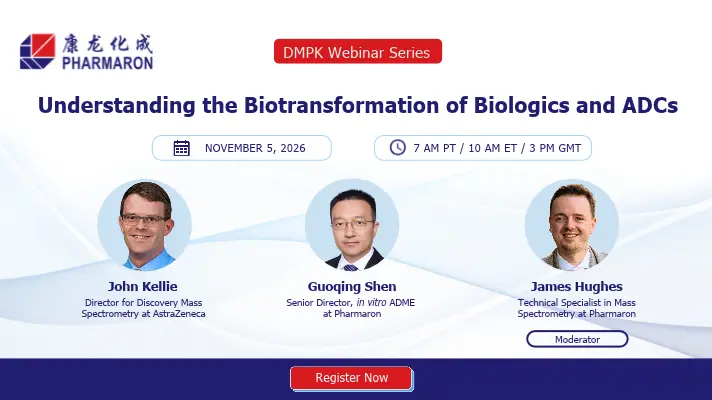
Understanding Protein Biotransformation of Biologics and ADCs
Capabilities
Date: November 5, 2026
7 am PT / 10 am ET / 3 pm GMT
How can mass spectrometry help us understand ADC stability, biotransformation and payload release?
Biological mass spectrometry is a powerful tool for understanding the biotransformations and catabolism of large molecule constructs. This webinar discusses how high-resolution mass spectrometry impacts the characterisation of large, complex modalities such as antibody-drug conjugates (ADC) and workflows available to drive adequate sensitivity and selectivity.
About our DMPK Webinar on Biotransformation
Discover how intact, reduced and peptide-level mass spectrometry can provide a more complete understanding of biologic and ADC biotransformation. Through practical workflows and case studies, this presentation explores ADC structure, linker and payload behaviour, DAR stability, payload release, metabolite identification and chemical modification. Attendees will learn how complimentary in vitro, in vivo and bioanalytical tools can be leveraged to help drive more informed decisions during ADC discovery and development.
What You’ll Learn
By attending this webinar, participants will learn about:
- How antibody, linker and payload chemistry can impact ADC stability, biotransformation and payload release
- Cleavable vs. non-cleavable linkers and their effect on ADC catabolism and metabolite profiles
- How to apply complimentary LC-MS techniques to quantify total antibody, total ADC, free payload and drug-antibody ratio (DAR)
- Practical strategies for using intact and reduced mass spectrometry to track changes in DAR, ADC stability and biotransformation
- How in vitro models can be used alongside in vivo bioanalysis to gain further insights into ADC catabolism, payload release and metabolism
- Using high-resolution MS and peptide mapping to identify metabolites, catabolites and chemical modifications.