Virtual Lecture Series - [2+2]-Cycloadditions to in situ Analytical Data-Driven Electrochemical Optimization
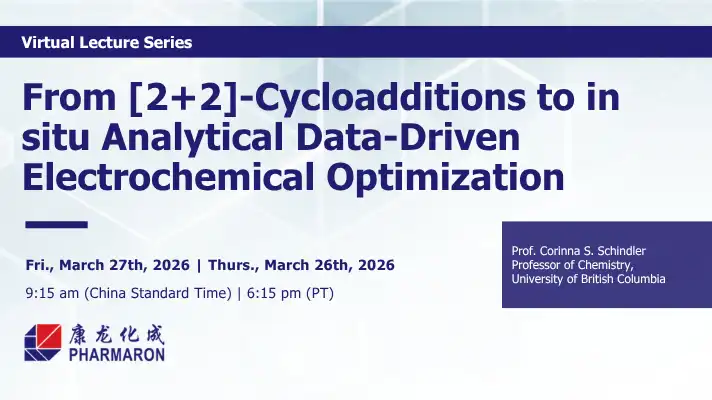
Lecture Date: Fri., March 27, 2026, 9:15 am (China Standard Time), Thurs., March 26, 2026 6:15 pm (PT)
About our Virtual Chemistry Lecture on in situ Analytical Data-Driven Electrochemical Optimization
In this session, Prof. Schindler will explore an innovative method for data-driven reaction optimization that finally makes electrochemical measurements feasible at scale. It is known by chemists that electrochemistry can offer a direct, physically grounded probe of reaction environments. The problem is that the most useful measurements are usually slow, low‑throughput, and are difficult to integrate into modern machine-learning workflows.
Prof. Schindler’s introduces a new in situ electrochemical optimization framework that combines custom parallelized hardware, automated data processing, and machine learning to allows high-throughput acquisition and encoding of electrochemical descriptors for reaction modeling. Central to the system is a parallel three‑electrode array that can run non-destructive electroanalytical measurements prior to electrolysis, without changing the reaction setup, meaning every reaction is matched with descriptors that reflect its electrochemical environment. This, combined with automated data‑processing tools, computer‑vision–based feature extraction, and Bayesian optimization, creates a workflow that can explore large reaction spaces quickly and with impressive data efficiency.
Capabilities
Throughout her presentation, Prof. Schindler will illustrate how these different elements work together to form a systemic platform for scalable reaction optimization and predictive modeling. This talk will also touch on the broader impact this approach could have on accelerating discovery and provide chemists with a clearer, more actionable view of electrochemical reactivity.
About our Speaker
Professor Schlindler
Prof. Schindler was born and raised in Schwaebisch Hall, Germany. From 1999 to 2004, as an undergraduate at the Technical University of Munich, she worked in the area of organometallic chemistry. Upon completion of her Diploma Thesis at the Scripps Research Institute in La Jolla in the laboratory of K.C. Nicolaou, she joined the research group of Erick M. Carreira at the ETH Zurich in Switzerland for her graduate studies from 2005 to 2010, where she earned her Ph.D. During her time in the Carreira group, Prof. Schindler developed novel synthetic methodologies and successful synthetic strategies to access Banyaside A and Microcin SF608. For her postdoctoral studies from 2010 to 2013, Corinna joined the laboratory of Eric N. Jacobsen at Harvard University as a Feodor Lynen Postdoctoral Fellow to work in the field of asymmetric catalysis. In September 2013, she began her independent academic career as an Assistant Professor at the University of Michigan, College of Literature, Science, and the Arts. She was promoted to Associate Professor in September 2019 and to Professor in September 2021 at the same institution. In 2024, she moved to the University of British Columbia in the Department of Chemistry as a Professor.
About the Virtual Chemistry Lecture Series
Pharmaron’s monthly Virtual Lecture Series provides our team and partners with online educational opportunities. World-class academic researchers are invited to present novel research related to synthetic and medicinal chemistry through this virtual forum.