Preclinical Safety Assessments for Genetically Modified Bacteria
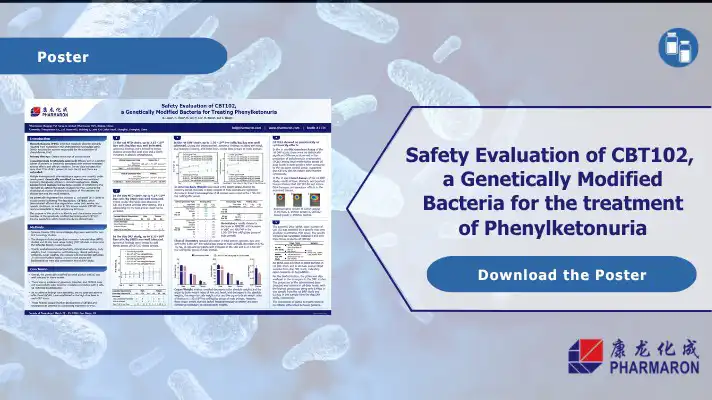
Poster Authors:
X. Liang, H. Chen, H. Lu, Y. Liu, B. Xiang, and J. Wang
Pharmaron (Beijing) TSP Services Limited, Beijing, China
CommBio Therapeutics Co., Ltd., Shanghai, China
This poster was presented at the 65th Annual meeting for the Society of Toxicology (SOT), March 2026
Integrated Safety Testing for Genetically Engineered Bacteria
Pharmaron offers comprehensive, nonclinical safety evaluation for genetically modified bacterial therapeutics across rodent and non-rodent models, supporting their progression from preclinical to clinical development. In this case study, the genetically engineered bacteria, CBT102, was evaluated for tolerability; effects on body weight, food consumption, organ weights and histopathology, along with assessment of cytotoxicity and biomarkers. The evaluation of systemic exposure was assessed by quantitative PCR, to confirm gastrointestinal restricted exposure and evaluate clearance.
By combining specific regulatory aligned preclinical safety assessments with exposure and clearance analysis, Pharmaron provides tailored strategies to de-risk genetically engineered bacteria and other live biotherapeutics, thereby confidently supporting regulatory submissions.
Case Study: Safety and Biodistribution Assessment of Genetically Modified Bacteria (GMB) CBT102
A comprehensive safety assessment strategy was conducted to characterize the toxicological profile, systemic exposure, and genotoxic risk of the engineered bacterial therapeutic:
Capabilities
- In vivo MTD and 14 day DRF studies were conducted in rat and dog models to characterize the dose-dependent tolerability of the engineered bacterial therapeutic, CBT102.
- A full toxicology screening was performed, including clinical observations, body weight, clinical pathology, and comprehensive histopathology to evaluate systemic and local effects.
- Biodistribution and systemic exposure were characterized by using qPCR to detect bacterial DNA in blood and organs, assessing tissue distribution and clearance.
- In vivo genotoxicity was assessed in rats, to detect cytotoxicity and DNA damage across multiple tissues by conducting micronucleus and comet assays.
- Electrocardiogram assessments were performed in dogs, with no test article-related changes observed; therefore, the data was not included in the poster.
- The NOAEL and overall safety profile was established based on tolerability, absence of genotoxicity, and minimal systemic exposure.
Download the Poster
Download the full poster to learn more about the integrated approach for GM bacteria safety.
