Target Identification Through in vivo CRISPR Screening

Poster Authors:
Ce Zhong, Lu Bai, Tongtong Wang, Yiying Shao, Lingyun Zhang, Lu Zhang, Jingqi Huang
1in vivo Pharmacology, Pharmaron Beijing Co., Ltd. (China)
in vivo CRISPR Screening Identifies Disease Drivers in the Tumor Environment
Conventional target identification approaches are often performed in vitro and may fail to fully capture the physiological complexities of a tumor. Through in vivo CRISPR screening, Pharmaron scientists perturb thousands of genes simultaneously in tumors growing in animals to reveal drivers of tumor growth and drug resistance.
Which information can be gained with in vivo CRISPR screening?
- Unbiased evaluation of thousands of genes in a single study
- Evaluation of gene function in the physiological tumor environment
- Identification of resistance mechanisms to drug treatment
- Discovery of biomarkers associated with drug resistance
- Identification of targets for combination treatment
Case Study of in vivo CRISPR Screening to Identify Genes that Influence the Response to Trametinib Treatment
The poster shows how in vivo CRISPR screening is used to identify genes whose knockdown increases or decreases tumor cell survival during treatment of the MEK1/2 inhibitor trametinib.
Capabilities
Study Objectives:
- Identify genes whose loss causes tumor cells to disappear during Trametinib treatment, indicating targets for combination treatment.
- Identify genes whose loss causes tumor cells to better survive during Trametinib treatment, contributing to drug resistance.
Study Design: in vivo CRISPR Screening under Drug Pressure
A549 human lung tumor cells were transfected with 3,188 single guide RNAs (sgRNA) targeting tumor suppressor genes, with one sgRNA per cell. The study design comprised three study groups:
- Tumors implanted in mice and subsequently treated with either vehicle or Trametinib
- Tumor cells grown in vitro cell culture as engineered controls
After three weeks, the tissues were amplicon sequenced to identify residual sgRNAs, which represent genes that provided a survival advantage.

Study Results
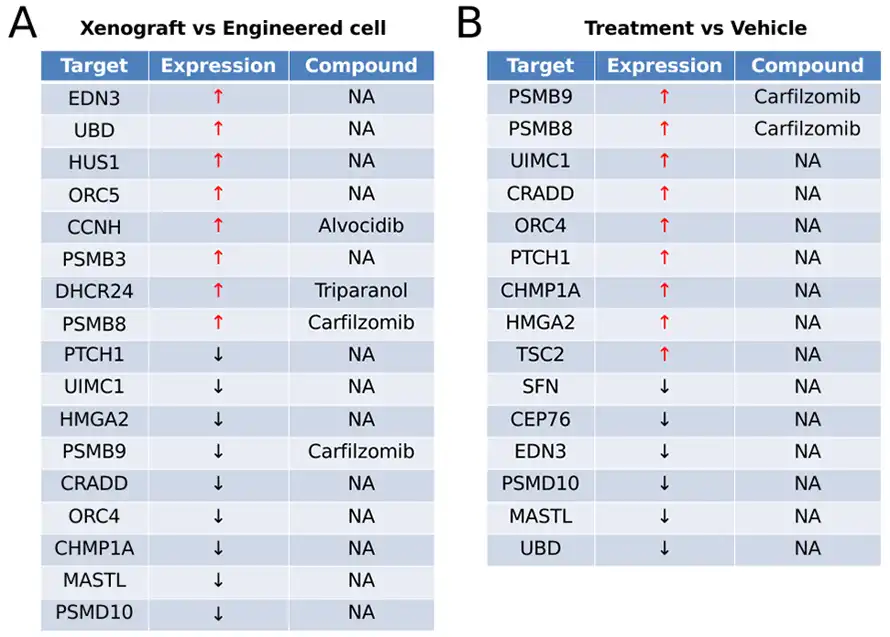
The screen identified multiple genes when comparing in vitro-grown cells with in vivo-grown tumors (see table A), as well as when comparing vehicle versus- and trametinib-treated tumors (see table B). The screen identified genes whose knockout either promoted or impaired tumor growth under the pressure of the in vivo physiologic environment (A) or treatment pressure (B).
Explore the full study design, gene enrichment analysis, and identified targets by downloading the poster.