Challenges Navigating an IVD Submission in the European Union
Poster Authors:
Thomas Klem, Gerald Craig, Benjamin Bronfin
Pharmaron US Lab Services, Woburn, MA, United States
IVDR Submission
Gene therapy researchers working in the EU face regulatory challenges when clinical programs depend on diagnostic assays. An IVDR formal submission is required when an assay is used to screen or enroll patients, like NAb for AAV-based therapies, prior to commercial use. The IVDR was designed to harmonize how in vitro diagnostic devices are reviewed and approved across the EU. As an evolving process, each submission is unique with country-specific requirements and varying Ethics Committee contributions.
For sponsors developing AAV-based gene therapies, NAb assays being used to exclude patients with pre-existing immunity are considered a medical device under IVDR. Because approval is required prior to clinical trials, delays in the IVDR submission process can directly stall enrollment timelines.
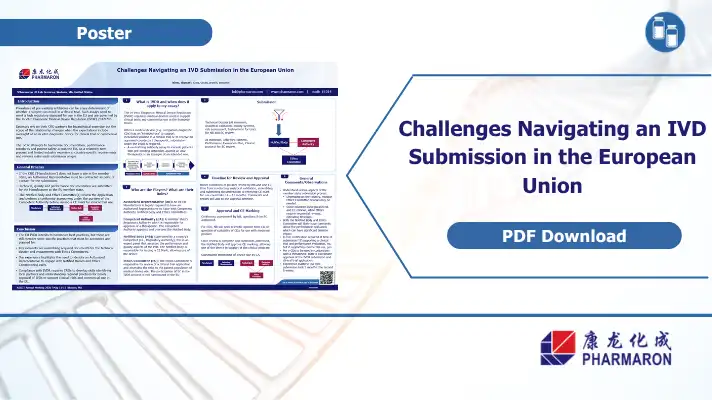
This poster, from Pharmaron’s bioanalytical team at ASGCT 2026, walks through the necessary steps of this process including who is involved, what documentation is required, and where timelines can stall.
Capabilities
IVDR Process Overview
Several groups contribute to the reviewing and approving an IVD for clinical or commercial use in the EU. These groups are:
- Authorized Representative (AR): Required when the manufacturer (often the CRO) does not have a physical site in the EU region, serving as the point of contact for regulators.
- Competent Authority (CA): The region’s regulatory authority, overseeing the Notified Body and holds final authority of device approval.
- Notified Body (NB): An expert panel that reviews key performance aspects of the IVD, and ultimately issues the CE mark.
- Ethics Committee (EC): Reviews the clinical trial application and assesses patient risk. EC involvement in the IVDR process is not harmonized across EU countries.
What a Typical IVDR Submission Requires
The manufacturer submits a technical dossier to the relevant EU member state. At minimum this includes analytical validation data, quality system documentation, a risk assessment and Instructions for Use. The Ethics Committee review requires informed consent documents, a Performance Evaluation Plan and the clinical protocol.
Under parallel review by the Notified Body and one Ethics Committee, the process from completing analytical validation through CE marking can take 12 to 16 months. Questions and responses from either body will extend that timeline.
Where Timelines Can Expand
- Some member states require multiple Ethics Committee reviews
- Sequential (not parallel) Notified Body and Ethics Committee reviews extend timelines further
- Performance evaluation comments from either body can cause significant delays
For companion diagnostics the Notified Body must also seek a scientific opinion from the Competent Authority on the device’s suitability for use with the therapeutic
CRO Experience Makes a Measurable Difference
Pharmaron’s experience with IVDR submissions shows the significance of process familiarity. Our first submission took approximately nine months, the second was completed in eight weeks. This acceleration comes from understanding state specific requirements, identifying the right Authorized Representative early, and establishing clear responsibility boundaries with the sponsor.
Download the Poster
Download the full ASGCT 2026 poster to review the complete IVDR submission process, including practical observations from Pharmaron’s submissions.
References:
