Modelling Chromatography for Precision Separation of Full and Empty AAV Capsids
Poster Authors:
Nicholas Pearman, Taelor Patterson, Amy Hawksworth, Chris Sadler
Pharmaron, 12 Estuary Banks, Liverpool, L24 8RB, UK
Mechanistic Modelling
Separating genome-containing (full) AAV capsids from non-genome-containing (empty) capsids can be difficult due to empty capsids not carrying the therapeutic transgene but still provoking an immune response in patients. This makes effective capsid separation essential to both product quality and patient safety.
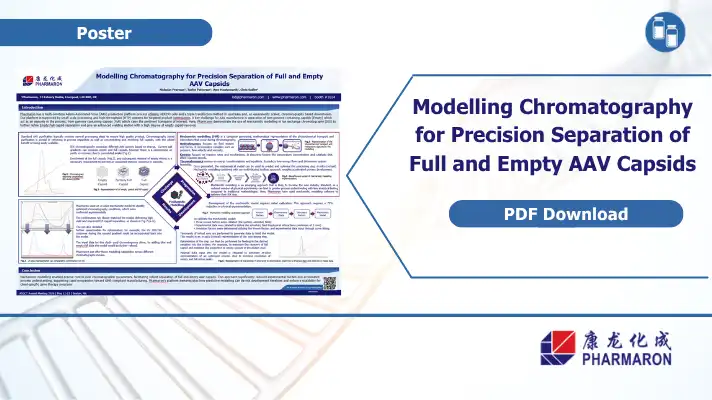
In this poster presented at the American Society of Gene & Cell Therapy (ASGCT) 2026 Annual Meeting, Pharmaron demonstrates the use of mechanistic modelling in ion exchange chromatography (IEX) to improve the resolution between full and empty AAV capsids while reducing the experimental burden on process development teams.
Capabilities
Why Capsid Separation Matters
Current salt gradient methods used in IEX chromatography can distinguish full and empty capsids based on surface charge differences. However, convoluted elution peaks often force a compromise between purity and recovery. This trade-off creates risk at every stage of scale-up and can delay progression toward GMP manufacturing.
Traditional optimization relies on repeated physical experiments and extensive analytical testing. Each cycle adds time and cost to development program that are already under pressure to reach the clinic quickly.
What Mechanistic Modelling Offers
Mechanistic modelling (MM) is a computer-generated mathematical representation of the physicochemical transport and interactions that occur during chromatography. It captures hydrodynamics, kinetics and thermodynamics in a single framework that can be used to predict and optimize processing steps in silico.
Rather than running dozens of bench-scale experiments, development teams can use a calibrated model to test thousands of virtual conditions and identify the optimal parameters before confirming them with a small number of physical runs.
What You Will Learn
This poster details how mechanistic modelling was applied to the IEX step in their multi-serotype AAV production platform. Key topics include:
- How the mechanistic model was calibrated using minimal experimental input
- The reduction in physical experimentation and analytical testing achieved
- Experimental confirmation of in-silico predictions for capsid separation
- Opportunities to extend modelling across additional chromatography modes
Download the poster to see the full calibration approach, in silico versus empirical data comparisons and results from the confirmation run.
References:
- FDA: CMC Information for Human Gene Therapy INDs
- Separation of full and empty AAV capsids by anion-exchange chromatography (PubMed)
- ICH Q8(R2): Pharmaceutical Development (Quality by Design)
- Membrane chromatography for AAV full capsid enrichment (PubMed)
- EMA: ICH Q8(R2) Pharmaceutical Development Scientific Guideline