Ocular Buffers and Formulation Safety in Posterior Segment Gene and Cell Therapy
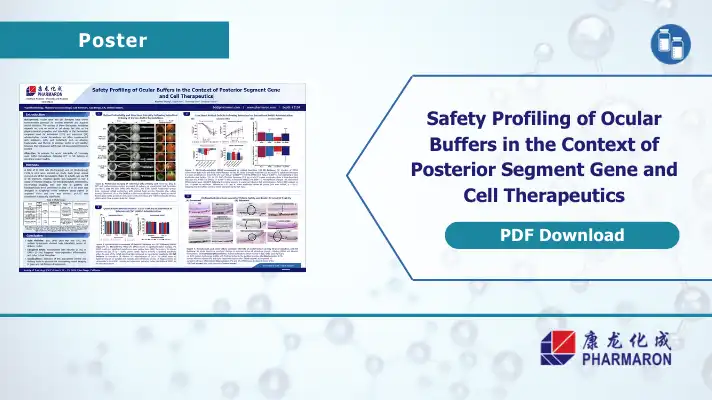
Poster Authors:
Xiaohui Zhang, Sudan Puri, Glenwood Gum, Sandeep Kumar
Ophthalmology, Pharmaron (San Diego) Lab Services, San Diego, CA, United States.
Ocular Buffer Tolerability in Gene and Cell Therapies
Ocular gene and cell therapies have shown transformative potential for treating inherited and acquired retinal disorders. The success of these therapeutic modalities depends not only on vector or cell design but also on the physicochemical properties and tolerability of the formulation excipients used for intravitreal (IVT) and subretinal (SR) administration.
The objective of this study is to evaluate the ocular tolerability of commonly used buffer formulations following IVT or SR delivery in preclinical rodent models.
Choosing the Right Ocular Buffer
Buffers used in eye injections often contain stabilizers, salts and surfactants. These ingredients protect the viral vector or cell payload. Some of these variations are not well-tolerated once inside eye tissue and the route of administration can impact the success of tolerability.
Two common approaches are:
- Intravitreal
- Subretinal (SR) injection
For retinal disease programs, a poorly tolerated buffer creates safety signals that are hard to separate from the therapy itself. Catching this early saves time and resources.
Capabilities
Study Design
A total of 60 RNU rats (N=10/group) and 20 (N=10/group) C57BL/6 mice were enrolled in the study. Each group animal received one of several different formulations in both eyes via IVT or SR injections.
Retinal health was assessed using:
- OCT (optical coherence tomography) for structural imaging
- ERG (electroretinography) to measure retinal function
- H&E histopathology for tissue analysis
Evaluations were performed at Day 14 or Day 30 after injection.
Why these findings matter
Buffer choice and delivery route must be evaluated together. Carrying DMSO or albumin into a regulated study without route-specific safety data adds unnecessary risk and confounding signals at a late stage are costly to resolve.
Pharmaron’s ophthalmology team supports formulation screening, preclinical ocular safety studies and IND-enabling toxicology programs.
References
Download the poster to learn how these studies may apply to your formulation development program.