High-Throughput Peptide Oral Bioavailability Screening
Poster Authors:
Jiahao Liu, Jianwei Jiang, Jing Ni, Rong Zhang, Qipeng He, Danxi Li, Mandy Xu
PK-ADME Department of Pharmaron, Beijing
Peptide oral bioavailability faces two gut obstacles: a mucus layer and the intestinal epithelium underneath. The ideal screen detects both, early and at sufficient throughput to prioritize a peptide library before selecting compounds for further study. Pharmaron’s Beijing-based in vitro ADME team developed a high-throughput workflow that simultaneously provides LogD profiling and permeability data across MDCK II and Caco-2 monolayers (both with and without permeation enhancers) and overlays those data onto a Caco-2 model pre-coated with biosimilar mucus.
Poster presented at the 27th ISSX North American Meeting.
Please fill out form to download poster to the right.
Why is oral delivery difficult for peptides?
Peptides have wide clinical promise, but few permeate the intestinal epithelium enough to enable oral dosing. Mucus creates a second barrier in front of these cells. Efflux transporters also actively pump some peptides back out. Typical permeability assays can generate values too low to discriminate between candidates. This leaves project teams with no usable ranking.
How does the peptide permeability screening workflow work?
Beginning with LogD determined using the shake-flask method, this workflow initially ranks the library based on probable permeability potential. The low-LogD fraction is screened using MDCK II or Caco-2 monolayers in the presence of permeation enhancers to amplify the transport so small differences can be detected. Candidates from both low/high LogD groups are evaluated using the mucus- coated Caco-2 model which provides a final read under physiologically relevant intestinal conditions.
Capabilities
What do permeation enhancers add to the screen?
Pharmaron evaluated bovine serum albumin (BSA), sodium decanoate (C10) and Solutol as permeation enhancers. Both C10 and Solutol increased peptide transport across Caco-2 monolayers and enlarged the differences between peptides. BSA did not show any obvious effect. This helps to rank low-permeability peptides against each other.
Why add a mucus barrier model to Caco-2?
Coating Caco-2 monolayers with biosimilar mucus (BSM) restricted peptide permeation further than the standard model. The result is a closer approximation of the mucus barrier a peptide meets in the intestine.
Key takeaways
- Oral bioavailability of peptides is impacted not only by the intestinal epithelium but also by the underlying mucus layer. Screening platforms need to assess both.
- LogD profiling rapidly pre-sorts a peptide library by expected permeability.
- Use of selected permeation enhancers can increase the permeability gap between low-permeability peptides and enable ranking.
- Coating Caco-2 cells with mucus adds this critical barrier that is absent from traditional monolayer cell models.
What is in the poster?
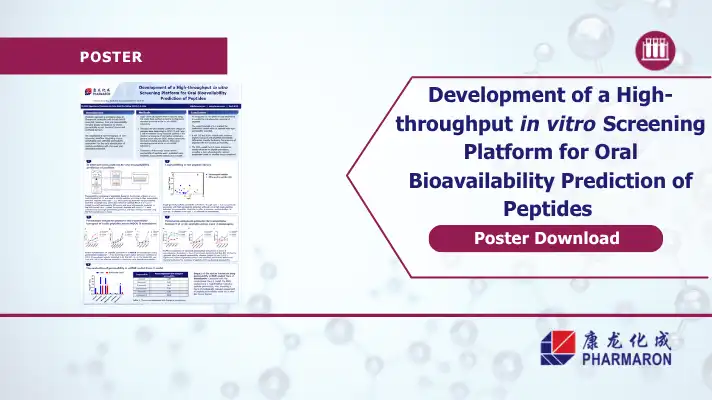
The poster contains the supporting data: LogD distribution of peptide library, enhancer screen data in MDCK II and Caco-2 cells and mucus-dependent permeability comparison of reference drugs and peptides.
Frequently asked questions
What limits peptide oral bioavailability?
Mainly poor permeability across intestinal mucus and the epithelial cell layer, with efflux transporters limiting some peptides further.
What is a biosimilar mucus Caco-2 model?
A Caco-2 cell monolayer coated with a mucus-like matrix, so permeability is measured through both mucus and cells.
Why use permeation enhancers in a permeability screen?
They raise transport of poorly permeable peptides into a measurable range, so candidates can be compared with each other.
Why measure LogD for peptides?
LogD reflects lipophilicity at physiological pH and gives a quick first indication of which peptides are likely to permeate cells.

Access Pharmaron’s data on Peptide Oral Bioavailability
References
1. Boegh M, et al. Biosimilar mucus in a mucus-containing in vitro model. Eur J Pharm Biopharm. 2014;87(2):227-235.
2. Boegh M, et al. Barrier properties of intestinal mucus and peptide permeation. Eur J Pharm Biopharm. 2015;95:136-143.
3. Twarog C, et al. Intestinal permeation enhancers: SNAC and sodium caprate. Pharmaceutics. 2019;11(2):78.
4. McCartney F, et al. Safety of intestinal permeation enhancers. Tissue Barriers. 2016;4(2):e1176822.
5. Baker C, et al. PEGASUS: cell-permeable cyclic peptides. J Med Chem. 2026;69(5):5175-5198.