Normative Retinal Structure and Function Across Preclinical Species: OCT and ERG Assessment
Poster Authors:
Sudan Puri; James Lee; Sujata Rijal; Vivian Trenti; Xiaohui Zhang; Yesica Chaparro; Hannah Gill; Marcela Duran; Manindra Singh; Matthew Lyulkin; Glenwood G Gum; Sandeep Kumar
Ophthalmology, Pharmaron US Lab Services, San Diego, CA, United States.
Preclinical OCT Assessment
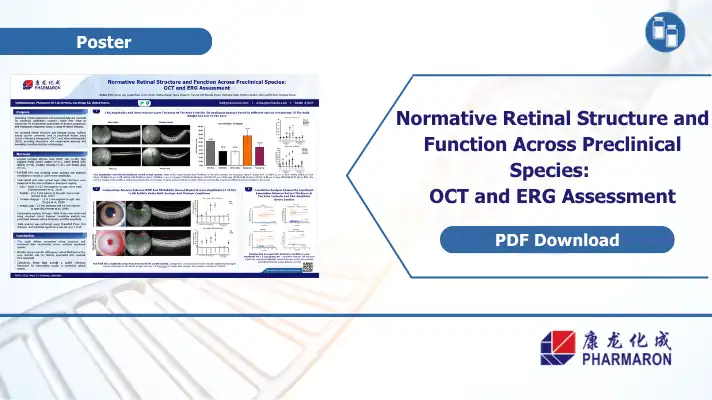
Preclinical OCT assessment provides reliable baseline measurements of retinal structure, a necessary step in ophthalmic drug development. This study characterized retinal anatomy and function across five common preclinical species using optical coherence tomography (OCT) and full-field electroretinography (ERG). The results, showing species specific datasets, were presented at the 2026 ARVO Annual Meeting in Denver.
Retinal Data in Preclinical ERG Assessment
Retinal thickness and electrical function measurements are tracked over time in order to gauge disease progression and treatment response. Species specific baselines allows researchers to confidently differentiate natural variations as a treatment effect or deviation. A preclinical ERG assessment loses value when there is no normative anchor for comparison.
This is especially relevant for programs targeting inherited retinal diseases, gene therapies and ocular drug delivery, where small shifts in outer nuclear layer (ONL) thickness or ERG amplitude can carry clinical significance.
Capabilities
Species in This Study
The study evaluated retinal structure and function in five common species:
- Athymic nude rats
- New Zealand White rabbits
- Dutch Belted rabbits
- Yucatan minipigs
- Beagle dogs
Supporting Preclinical Ophthalmic Programs
Normative datasets give teams a reference framework for designing and interpreting preclinical retinal studies, which can be used to:
- Select appropriate model based on retinal anatomy and functional profile
- Identify meaningful study endpoints for OCT and ERG measurements
- Discern treatment related changes from natural species variation
- Compare results from different animal model studies
- Support regulatory submissions
Pharmaron’s ophthalmology team performs OCT imaging and ERG testing as part of integrated preclinical ophthalmic study packages. These services support toxicology assessments, gene therapy efficacy studies, and device evaluations for ocular programs.
References:
Download the Poster
Download the full ARVO 2026 poster to access the full study.
