Species Differences in Harvestable Ocular Tissue Weights for Preclinical Ophthalmic Drug Development
Poster Authors:
Xiaohui Zhang; Carly Boyd; Stephanie Peters; Hannah Gill; Sudan Puri; Manindra Singh; Matthew Lyulkin; Glenwood Gum; Sandeep Kumar
Pharmaron (US) Lab Services LLC, San Diego, 92010, CA, United States
Preclinical Ocular Tissue Testing
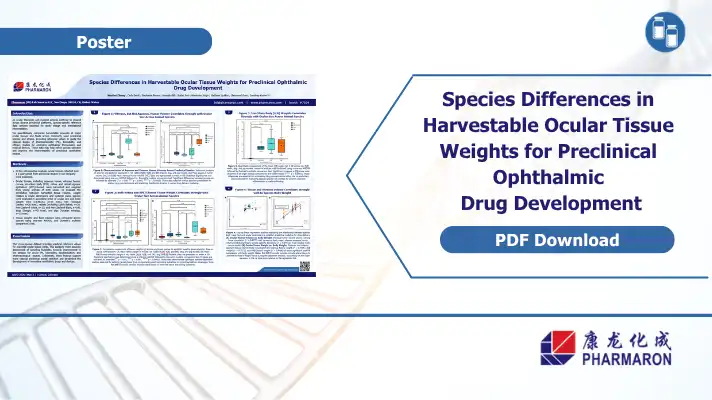
This ARVO 2026 poster on preclinical ocular tissue testing presents a five year analysis comparing harvested a variety of ocular tissues across mice, rats, multiple rabbit strains, dogs, and Yucatan minipigs. The tested tissues were aqueous humor, vitreous humor, retina, RPE/choroid and ICB.
Capabilities
Species Specific Data
Species selection for an ophthalmic drug development program impacts sampling feasibility, dose-to-tissue normalization, and how well preclinical results translate to the clinic.
For example, vitreous humor volume scales predictably with body weight, while aqueous humor does not. The impact of designing studies without species-level reference values could negatively impact tissue collection analysis.
Our Study
Pharmaron’s dataset spans more than 170 eyes across six species and multiple strains.
The analysis includes:
- Volumetric comparison of aqueous and vitreous humor across rats, rabbits (NZW, NZB, Dutch Belted), dogs, and pigs
- Tissue weight comparisons
- Allometric scaling analysis
- Statistical evaluation using one-way ANOVA with Dunnett’s multiple comparison test
These reference values help sponsors and study directors make better decisions about species selection before studies begin.
Pharmaron’s Ocular Platform
Pharmaron’s ocular facility supports a full range of services including toxicology, PK, efficacy, device testing, and cell and gene therapy (CGT).
References:
- FDA — Preclinical Assessment of Investigational Cellular and Gene Therapy Products (Guidance)
- NCBI/PubMed — Allometric scaling of ocular parameters
- FDA — Nonclinical Safety Evaluation of Drug or Biologic Combinations
Download the Poster
Download the full ARVO 2026 poster to review this study and use the reference values to strengthen your next study protocol.
