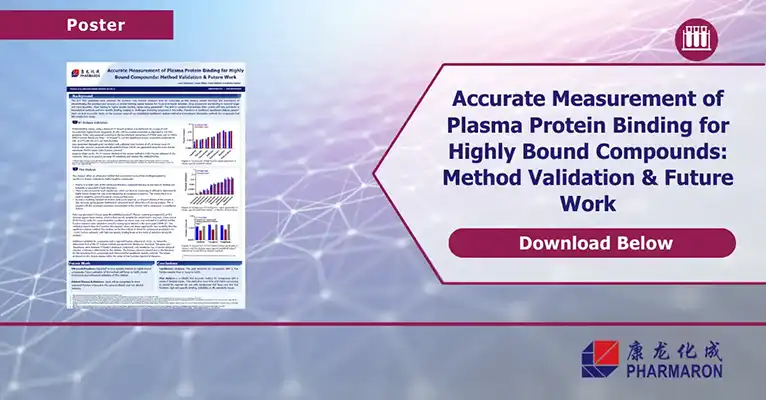
Accurate Measurement of Plasma Protein Binding for Highly Bound Compounds
Poster Authors:
Laura Tomlinson, Lerryn Hilton, Helen Rollison & Katherine Fenner
Pharmaron UK Ltd, Hertford Road Hoddesdon Hertfordshire, EN11 9FH, UK
Accurate protein binding assays are essential for understanding drug disposition, safety, and efficacy—especially for compounds with high plasma protein affinity. As regulatory expectations evolve under ICH M12, the need for validated, low-detection binding methods has never been more urgent.
Unlocking High-Accuracy Plasma Protein Binding Assays for Drug Discovery
When developing highly bound compounds, accurately measuring unbound drug levels in plasma is critical. An optimized protein binding assay enables confident decision-making in both discovery and regulatory phases. Pharmaron’s approach combines equilibrium dialysis and the advanced flux dialysis method to quantify unbound fractions as low as 0.001 (0.1%), aligning with updated ICH M12 guidance.
These capabilities are key for compounds with high lipophilicity, large molecular size, or low detection limits, all known to challenge traditional binding methods due to non-specific binding and MS sensitivity limits.
Why Accurate Protein Binding Assays Matter?
Capabilities
Challenges in Measuring Highly Bound Compounds
With evolving drug chemistry, many candidates exhibit extremely high plasma protein binding, often >99.9%. This makes accurate detection of the unbound fraction essential yet difficult. Standard methods may underperform when:
- Compound binding exceeds 99.9%
- Non-specific binding skews equilibrium
- Limits of detection (LOD) fall below quantifiable ranges
- Diluted plasma affects assay precision
Pharmaron addresses this with two validated strategies.
Advanced Methods: Equilibrium Dialysis and Flux Dialysis
Equilibrium Dialysis Method
Still regarded as the gold standard, this method is best suited for compounds with unbound fractions ≥0.001. Pharmaron’s HT Dialysis setup follows ICH M12-aligned bioanalysis procedures and demonstrates strong correlation with literature benchmarks.
- Ideal for stable, less lipophilic compounds
- Effective for reporting under revised ICH M12 criteria
- Enables cross-study comparability
Flux Dialysis Method
This modern alternative offers key benefits for highly lipophilic or unstable molecules:
- Removes the need to reach full equilibrium
- Eliminates matrix dilution
- Mitigates non-specific binding losses
- Achieves reliable data <0.001 fraction unbound
Flux dialysis places plasma on both sides of the membrane, reducing variability and increasing detection confidence for MS-limited compounds.
Practical Applications and Future Directions
Pharmaron’s methods are being validated across various compound types, including Venetoclax and Verlukast. The goal is to extend accurate measurement capabilities to even the most challenging molecular profiles by:
- Enhancing MS sensitivity
- Confirming consistency in diluted vs. undiluted matrices
- Using orthogonal validation (e.g. ultracentrifugation for cross-comparison)
Download the poster to explore how our protein binding assay services support confident preclinical decisions and regulatory submissions—especially under the new ICH M12 framework.
References: