Radiolabelled Oligonucleotide ADME Studies Using Tritium
Poster Authors:
Sion Edwards1, Darren Price1, Matthew Shaw1, Thomas Gregson1, Ray Cooke2, Claire Henson2, Gemma Bullen-Clerkson2, Kathryn Webbley2
1 Pharmaron UK Ltd, Cardiff, United Kingdom,
2 Pharmaron UK Ltd, Rushden, United Kingdom
Radiolabelled oligonucleotide ADME studies track where an oligonucleotide goes in the body, how long it stays and how it is cleared, by attaching a radioactive tag that can be measured with high sensitivity. Pharmaron labels oligonucleotide therapeutics with tritium and has applied the approach across more than 20 oligonucleotide projects.
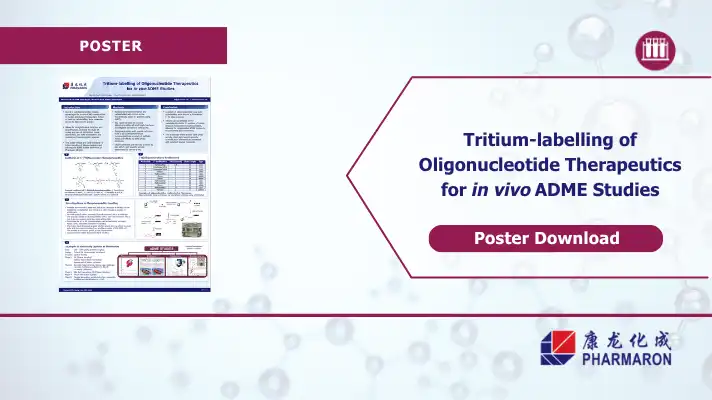
Pharmaron’s radiolabelling and drug metabolism and pharmacokinetics (DMPK) teams presented this work at a DMPK meeting in Oxford, UK in June 2026. The poster covers the labelling chemistry, the handling improvements behind it and the in vivo study options that follow. Complete the form to download it.
What are radiolabelled oligonucleotide ADME studies?
Absorption, distribution, metabolism and excretion (ADME) studies describe what the body does to a drug. For oligonucleotide therapeutics such as antisense oligonucleotides (ASOs), small interfering RNAs (siRNAs) and microRNAs (miRNAs), a radiolabel makes that picture measurable, supporting the study of elimination routes and rates, tissue distribution and chromatographic analysis. Regulators expect a nonclinical ADME package for these programmes, so radiolabelled studies are a standard way to build one.
Capabilities
Why use tritium for oligonucleotides?
Tritium suits large molecules because of its high specific activity, so a useful signal can be carried on a molecule the size of an oligonucleotide. High activity and short path length together allow tissue concentrations to be quantified with good spatial resolution, which is often the question an oligonucleotide programme needs answered.
How does Pharmaron label oligonucleotides with tritium?
Pharmaron installs tritium at the metabolically stable 5-prime position of nucleoside phosphoramidites, then builds the labelled unit into the full sequence by solid phase synthesis. Position matters because a label lost during metabolism stops reporting on the parent molecule. Finished oligonucleotides are purified and the specific activity confirmed before any study begins.
Reactive phosphoramidites are hard to handle at the small scales tritium work requires, and conventional purification can cost significant material. Pharmaron developed a rapid work-up that moves the labelled building block quickly into synthesis, improving yields and purities.
Which in vivo ADME studies follow?
Once a tritium-labelled oligonucleotide is in hand, Pharmaron runs the in vivo work programmes need: pharmacokinetics, tissue distribution including quantitative whole body autoradiography (QWBA), excretion balance, bile duct cannulation plus metabolite profiling and identification by liquid chromatography mass spectrometry (LC/MS). Designs cover several dosing routes and can run long enough to suit the slow tissue kinetics of this modality.
Key takeaways
- Tritium can be installed at the metabolically stable 5-prime position across a wide range of nucleoside phosphoramidites.
- Pharmaron has radiolabelled oligonucleotides across more than 20 projects, covering ASO, siRNA and miRNA formats.
- Improved phosphoramidite handling raises the yield and purity of labelled material at the small scales tritium work demands.
What is in the poster
The poster gives the labelling route, the range of oligonucleotides Pharmaron has prepared with their modifications and specific activities, the phosphoramidite handling investigation and the in vivo ADME study options with dose ranges, routes and study phases. Complete the form to download it.
Frequently asked questions
What is a radiolabelled oligonucleotide ADME study?
It is a nonclinical study that uses a radioactive tag on an oligonucleotide to measure absorption, distribution, metabolism and excretion in vivo.
Where is the tritium placed on an oligonucleotide?
Pharmaron installs it at the metabolically stable 5-prime position of a nucleoside phosphoramidite, which is then built into the sequence by solid phase synthesis.
Which oligonucleotide types can be radiolabelled?
Pharmaron has labelled antisense oligonucleotides, small interfering RNAs and microRNAs across more than 20 projects.
What ADME studies can be run with a labelled oligonucleotide?
Pharmacokinetics, tissue distribution by QWBA, excretion balance, bile duct cannulation plus metabolite profiling and identification by LC/MS.

Download the poster for Pharmaron’s tritium labelling route for oligonucleotides and the in vivo ADME study options that follow.
References
- FDA. Nonclinical Safety Assessment of Oligonucleotide-Based Therapeutics (Draft Guidance for Industry, November 2024)
- Berman CL, et al. OSWG Recommended Approaches to the Nonclinical Pharmacokinetic (ADME) Characterization of Therapeutic Oligonucleotides. Nucleic Acid Ther. 2023;33(5):287-305. PMID 37590469.
- Graham MJ, et al. Tritium labeling of antisense oligonucleotides by exchange with tritiated water. Nucleic Acids Res. 1993;21(16):3737-3743. PMID 8367289.
- FDA. Safety Testing of Drug Metabolites (Guidance for Industry).
- EMA. ICH M3(R2) on non-clinical safety studies for human clinical trials and marketing authorisation.