Translational PBPK Modelling
Poster Authors:
Simon TaylorA, Dave LugoA, Simon TeagueA, Elnaz GozalpourA, Honglei WangB, Hongwen DuB, Hongyu ZhouB
A Pharmaron, Hoddesdon, UK
B Pharmaron Beijing, Co. Ltd.,
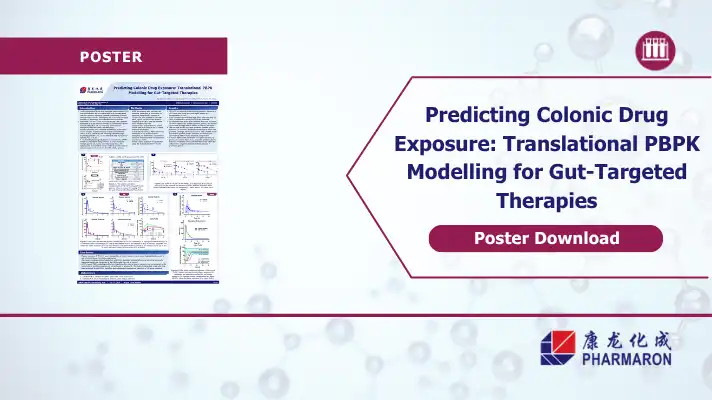
Predicting Colonic Drug Exposure Using Translational PBPK Modelling
For gut-targeted therapies, therapeutic activity is often driven by local tissue concentrations rather than systemic plasma exposure alone. However, directly measuring drug concentrations within gastrointestinal tissues is difficult because of complex physiology, invasive sampling requirements and substantial biological variability. As a result, physiologically based pharmacokinetic (PBPK) modelling provides a valuable framework for estimating tissue concentrations that cannot easily be measured in clinical studies.
This poster demonstrates how a translational PBPK model was developed and verified using rat plasma and colonic tissue data for izencitinib (TD-1473), a gut-selective JAK inhibitor. The model was subsequently translated to humans to estimate regional colonic drug exposure and assess whether sufficient concentrations were likely achieved to drive target engagement.
Download the poster by filling out the form to the right.
Capabilities
How can translational PBPK modelling help predict colonic drug exposure for gut-targeted therapies?
PBPK modelling uses mathematical equations to describe the ADME of drugs as they travel through organ systems, accounting for drug transporters and metabolic enzymes. Because direct measurement of gastrointestinal tissue concentrations is difficult, translational PBPK modelling allows for mechanistic prediction of drug exposures at the site of drug action. Integration of ADME properties, preclinical PK/pharmacokinetics, tissue distribution experiments, and physiological characteristics into a PBPK model can provide estimates of regional colonic exposure. Translation from animals to humans can assist in gaining further understanding of target engagement, better development decisions and decreased uncertainty moving gut-targeted therapies forward into clinical settings.
The Challenge of Translating Gut-Targeted Therapies
Izencitinib (TD-1473) was developed as an oral gut-selective JAK inhibitor for inflammatory bowel disease. While preclinical studies demonstrated biologically relevant colonic concentrations and pharmacodynamic activity, clinical development raised questions about whether sufficient target engagement was achieved in humans.
The research described in this poster explored whether mechanistic PBPK modelling could explain differences between preclinical and clinical outcomes by predicting regional colonic exposure.
Building a Translational PBPK Model
The modelling approach combined:
- Literature-derived ADME parameters
- Experimental data generated at Pharmaron
- Predicted physicochemical properties
- Rat plasma pharmacokinetics
- Portal vein pharmacokinetics
- Gastrointestinal tissue distribution data
- Human physiological parameters
A GastroPlus® GPX.2 PBPK model was first developed in rats to characterize absorption, gastrointestinal distribution and systemic exposure before being translated and optimized for human predictions.
Key findings
Plasma exposure did not reflect colonic drug levels
The study showed that plasma concentrations were not predictive of colonic tissue exposure, highlighting the limitations of relying solely on systemic pharmacokinetic measurements when developing gut-targeted therapies.
Understanding MDR1 efflux was critical
TD-1473 demonstrated high efflux activity consistent with MDR1-mediated transport. Incorporating this mechanism into the PBPK model was essential for accurately describing absorption, tissue distribution and translation between species.
The PBPK model successfully translated across species
The rat PBPK model accurately described plasma exposure and showed good agreement with observed gastrointestinal tissue concentrations. Following translation to humans, the model successfully predicted clinical plasma exposure and estimated regional colonic concentrations.
Human colonic exposure may have limited target engagement
Model predictions suggested that colonic concentrations achieved in humans were within the range of cellular JAK IC₅₀ values but lower than concentrations achieved in preclinical species and below estimated IC₉₀ values. This provided a mechanistic explanation for the observed clinical outcome.
Frequently asked questions
Why is plasma exposure not enough for gut-targeted drugs?
Plasma concentrations may not accurately reflect drug levels at the gastrointestinal site of action, making tissue exposure assessments critically important.
What is translational PBPK modelling?
Translational PBPK modelling uses mechanistic models and experimental data to predict how drug exposure translates from preclinical species to humans.
How can PBPK models support target engagement assessments?
PBPK models can estimate tissue concentrations that are difficult to measure directly and compare them with pharmacological potency targets.

Explore Pharmaron’s translational PBPK modeling approach.
References
1. Sandborn et al, Journal of Crohn’s and Colitis, 2020, 1202–1213
2. Hardwick R.N. et al., Toxicological Sciences, 2022,186(2), 323–337