FDA's New CMC Flexibility Guidance: What Cell & Gene Therapy Developers Need to Know

Capabilities
Authors:
- Ruchi Jhonsa, Project Manager – Cell and Gene Therapy
- Karen Doucette, Senior Director of CGT Project Management at Pharmaron
FDA formalizes a more flexible, risk-based approach to accelerating cell and gene therapy development
In May 2026, the FDA published its new guidance, Chemistry, Manufacturing, and Controls (CMC) Flexibilities for Developing Human Cellular and Gene Therapy Products for a Biologics License Application (BLA)1. While many of these regulatory approaches have already been applied in practice through product-specific interactions between sponsors and FDA, the CGT regulatory guidance consolidates FDA’s current thinking into a single resource.
Existing programs and designations, including Fast Track, Breakthrough Therapy, RMAT, Platform Designation, Priority Review, and Accelerated Approval, can facilitate product development, increase opportunities for FDA interaction, or expedite review. However, these programs do not independently address CMC readiness. The new guidance provides greater clarity on when sponsors may propose scientifically justified, nontraditional CMC approaches to support licensure under a BLA.
During a recent FDA webinar2, reviewers emphasized that the goal is not to lower regulatory standards, but to acknowledge the unique manufacturing and development challenges associated with cell and gene therapies and apply science- and risk-based regulatory judgment throughout product development.
Why This CGT Regulatory Guidance Matters
Cell and gene therapies differ significantly from traditional biologics. Developers frequently face:
- Small patient populations
- Limited manufacturing runs
- Complex and evolving manufacturing processes
- Short product shelf life
- Patient-specific manufacturing
- Limited clinical material for analytical development
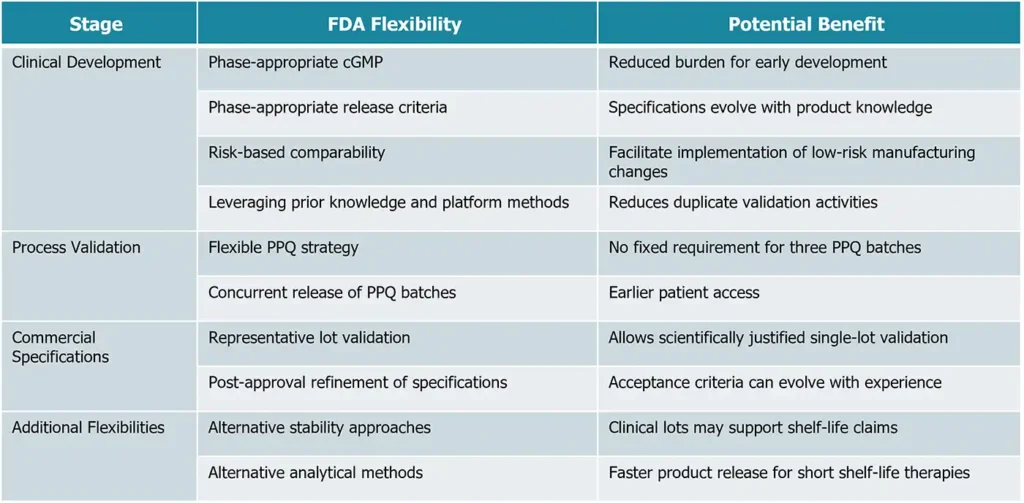
Recognizing these realities, FDA outlines several areas where sponsors may justify alternative CMC approaches while still demonstrating that products remain safe, pure, and potent. The four main areas where CMC flexibilities are acknowledged are summarized below and include clinical development, process validation, commercial specifications, and additional flexibilities.
These approaches should be scientifically justified and discussed with FDA early during development.
CMC Flexibilities at a Glance
Key Messages from FDA
FDA emphasized several practical themes during the webinar:
- CMC development should be viewed as a lifecycle process.
- Specifications should mature as manufacturing knowledge grows.
- Manufacturing changes should be supported by risk assessments.
- Sponsors should leverage prior knowledge whenever scientifically appropriate.
- Early and frequent FDA interactions remain critical to successful implementation of regulatory flexibility.
Real-World Examples of Regulatory Flexibility
In the last ten years, over 40 CGT products have been approved by FDA. While product-specific discussions are generally confidential between FDA and sponsors, some regulatory flexibilities can be inferred through publicly available SBRAs and approval letters available on FDA’s website. For example, in 2017, the first FDA-approved AAV gene therapy product, Luxturna, leveraged a single DP lot for process validation and included seven (7) CMC postmarketing commitments. One such commitment was that the manufacturer, Spark Therapeutics, Inc., had to analyze the lot release test results obtained from all Drug Substance (DS) and Drug Product (DP) lots manufactured within a set time following approval to evaluate if the acceptance criteria continued to provide adequate quality control for DS and DP3. This product-specific approach reflects FDA’s approach to flexible PPQ strategy and post-approval refinement of specifications.
Beginning in 2025, FDA also began acknowledging the specific regulatory flexibilities employed for a product’s approval in the Summary Basis for Regulatory Action (SBRA). For example, the SBRA for PAPZIMEOS, an adenoviral vector based gene therapy approved in August 2025, states that the CMC flexibilities included “allowing final process validation report as post-marketing commitment and concurrent release of PPQ lots.”4 Similarly, the SBRA for WASKYRA, an autologous gene-modified cell therapy product approved in December 2025, explains how FDA applied flexibility related to potency assurance and analytical validation by balancing pre- and post-approval expectations for CMC data5.
Together, these approval documents and FDA’s new guidance may help future CGT sponsors reduce regulatory uncertainty while preparing for BLA submissions.
What This Means for Developers
The takeaway from the new guidance is that FDA is formally recognizing that cell and gene therapy products often require a different CMC development paradigm than traditional biologics.
- Rather than applying a one-size-fits-all approach, FDA is encouraging sponsors to:
- Develop risk-based CMC strategies
- Leverage prior knowledge and platform technologies
- Justify alternative validation approaches scientifically
- Engage early and frequently with FDA review teams
- Focus resources on activities that most directly impact product quality and patient safety
For emerging biotechnology companies, particularly those developing therapies for rare and ultra-rare diseases, these flexibilities may significantly reduce development risk while maintaining rigorous quality expectations.
Take-Home Message
FDA’s 2026 CMC Flexibility Guidance represents an important milestone for the cell and gene therapy industry. By formalizing many of the science- and risk-based approaches already being applied in practice, FDA has provided sponsors with greater transparency and predictability as they prepare for BLA submission. For the next generation of cell and gene therapy innovators, the guidance offers a clearer roadmap for navigating CMC development while maintaining the ultimate goal of delivering safe, effective, and high-quality therapies to patients with significant unmet medical needs.
Pharmaron has over 20 years of experience guiding sponsors through product-specific challenges associated with development of CGT products. Our experts will work with you to design phase-appropriate preclinical, bioanalytical, and analytical workflows based on the latest regulatory guidelines. Our cell-based potency assay specialists can also help integrate assay development, qualification, validation, and testing into a comprehensive potency assurance strategy that supports the product lifecycle and anticipated CMC approach.

Interested in learning how Pharmaron can support your CGT Regulatory Requirements?
References:
- FDA. Chemistry, Manufacturing, and Controls Flexibilities for Developing Human Cellular and Gene Therapy Products for a Biologics License Application (BLA): Guidance for Industry. MD: U.S. Food and Drug Administration; 2026.
- Webinar June 2026, USFDA: Overview of Chemistry, Manufacturing, and Control Flexibilities for Developing Human Cellular and Gene Therapy Products for a Biologics License Application
- Summary Basis for Regulatory Action, LUXTURNA, December 18, 2017, https://www.fda.gov/vaccines-blood-biologics/cellular-gene-therapy-products/luxturna
- Summary Basis for Regulatory Action, PAPZIMEOS, August 14, 2025, https://www.fda.gov/vaccines-blood-biologics/papzimeos
- Summary Basis for Regulatory Action, WASKYRA, December 9, 2025, https://www.fda.gov/vaccines-blood-biologics/waskyra