Driving Innovation in Drug Metabolism: Highlights from ISSX 2025
Capabilities
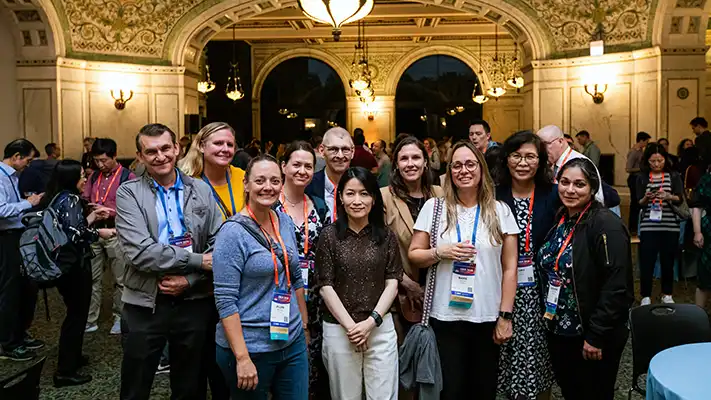
The 14th International ISSX Meeting was held at the Hilton Chicago from September 21–24, and leading scientists, industry experts, and service partners gathered to explore the topic of “New Frontiers and Challenges: Novel Therapeutic Modalities, Technologies, and Approaches.” At this year’s ISSX 2025 conference, Pharmaron was delighted to join the conversation around the evolving landscape of drug development. In particular, we presented how our collaborative work spans small molecules, biologics, and emerging therapeutic modalities with a variety of posters and live presentations. The discussions reflected the growing complexity of the field, and we were excited to share how our integrated approach is helping researchers navigate these new frontiers.
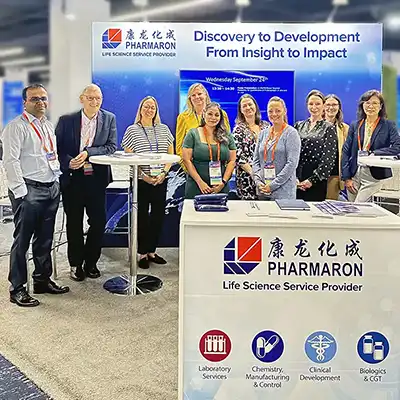
Our booth quickly became a hub for lively scientific exchange, where our experts from around the globe were on hand to discuss radiolabelled sciences, advances in DMPK methodologies and in vitro biology approaches.
Scientific Highlights & Reflections on the ISSX 2025 Conference
We asked our experts what they made of the event.
Marie Croft, Scientific Director of Radiolabelled Sciences:
“From the keynote on novel proteomics tools, through spirited debates on the role of AI, in vitro and in silico models vs. in vivo models in non-clinical research… the opportunity to connect with fellow scientists on recent advancements in AMS technology and its expanding role in supporting global Phase 1 development highlighted the importance of collaboration and innovation.”
Barry Jones, Chief Scientist, Global DMPK had praise for the quality of the conference program:
“The organizers really delivered an exciting meeting program and a vibrant atmosphere. The theme of ‘Novel Therapeutic Modalities, Technologies, and Approaches’ was superbly demonstrated in the plenary lecture, which showed advances in imaging techniques that have helped our understanding of the distribution of oligonucleotide drugs at the organ, cellular, and sub-cellular levels.”
Chunyan Han, Executive Director, ADMET :
“Translational science is essential for connecting discovery with clinical success. At ISSX 2025, we saw inspiring case studies of new modalities such as oligonucleotides, ADCs, and peptides reaching the market. These examples highlight the rapid progress in the field and strengthen our commitment to building strong translational capabilities to support such innovations.”
Talks & Posters
ISSX 2025 was more than a scientific meeting, it was an opportunity for attendees to present their latest research, share insights into new discoveries and enjoy open dialogue around the conference topics. For Pharmaron, this spirit of collaboration was key to the value conferences like ISSX present to the wider life sciences community. Our teams were proud to contribute to this through our talks and poster presentations, representing not only our own scientific expertise, but our commitment to advancing knowledge together.
Scientific AMS Talk
Marie Croft, Scientific Director of Radiolabelled Sciences
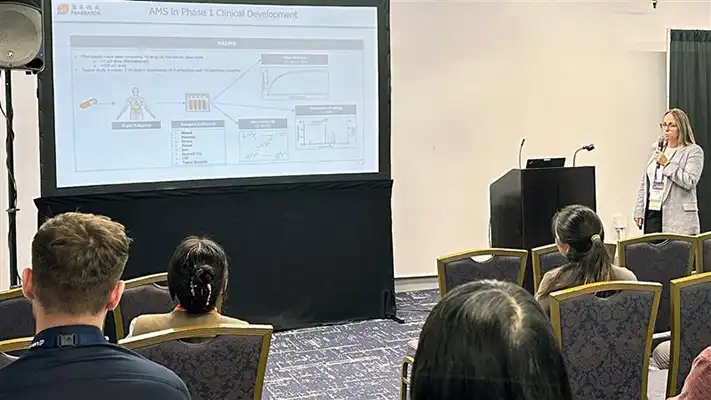
Marie Croft, Presenting: Accelerator Mass Spectrometry in Drug Development: Clinical Applications and Technological Advances
Accelerator Mass Spectrometry (AMS) is increasingly used in drug development to detect low levels of radiolabeled (14C) compounds, especially in clinical studies such as human absorption, metabolism, and excretion (hAME) and absolute bioavailability (hABA). Initially adopted for drugs with long half-lives or low exposure, AMS has gained broader acceptance following industry recommendations and FDA guidance. It is particularly valuable when conventional methods like liquid scintillation counting lack sensitivity, such as in studies with low plasma concentrations of parent drugs or metabolites.
In this presentation, we demonstrate the clinical applications and technological advancements of AMS, including its evolution from early graphite-based systems to the latest low-energy Ionplus LEA platforms now operational across Pharmaron’s global network.
Scientific Poster Presentations

Jessica Richardson, Senior Programme Manager, Metabolism
- A Single Dose Study to Assess the Mass Balance Recovery, Absorption, Metabolism, and Excretion of 14C-Paxalisib in Healthy Male Subjects After Oral Dosing
- By: Jessica Richardson, Senior Programme Manager, Metabolism
- Posters by Chunyan Han, Executive Director, DMPK:
- Assessing the nuclease resistance of oligonucleotide therapeutics in lysosomes: an in vitro study
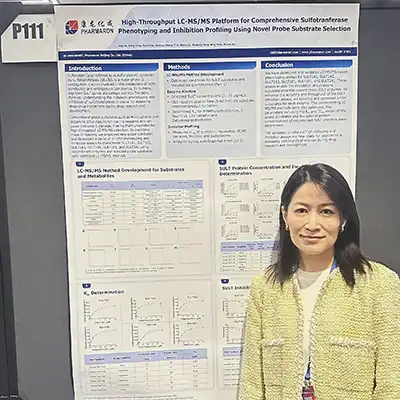
- High-throughput LC-MS/MS platform for comprehensive sulfotransferase phenotyping and inhibition profiling using novel probe substrate selection
- Co-culture rat brain microvascular endothelial cells and pericytes for high-throughput prediction of drug BBB permeability: validation with in vivo correlations
- Dissecting the impact of hepatocyte inactivation strategies on drug binding in primary hepatocyte assays
- LC-MS-based cholinesterase inhibition assay: high-sensitivity screening of inhibitors using recombinant ACHE and BCHE
- Determination of scaling factor ‘D’ for CYP induction studies
- LC-MS/MS targeted proteomics for precise quantification of P-glycoprotein in cell models
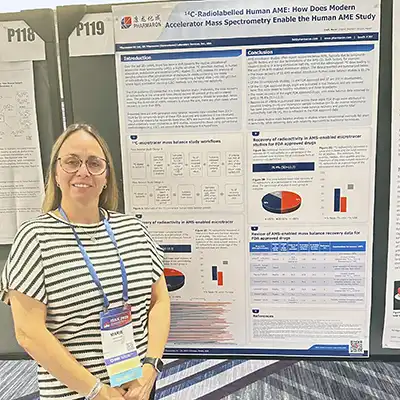
- Review of AMS mass balance recoveries for FDA-approved drugs
- By: Marie Croft, Scientific Director of Radiolabelled Sciences
- Evaluation of CYP3A4 Relative Induction Score (RIS) and its broader application for the induction of CYP2C, PGP, and UGT
- By: Guru Valicherla, Senior Scientist II, Regulatory in vitro ADME
- Stable Isotope Labeling by Amino Acid in Culture (SILAC) Approach for the Detection of Trapped Reactive Metabolites in Plated Hepatocytes
- By: Igor Mezine, Principal Research Fellow
- 14C-Radiolabelled Human AME: A review of clinical mass balance data
- By: Jessica Richardson, Senior Programme Manager, Metabolism
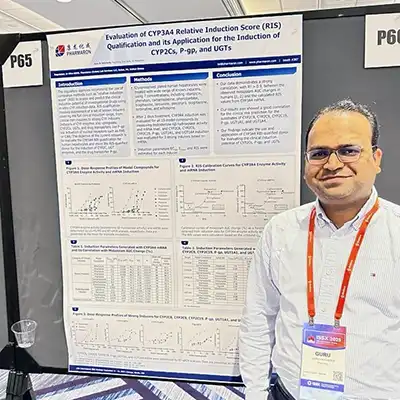
Guru Valicherla, Senior Scientist II, Regulatory in vitro ADME
Looking Ahead
ISSX is proof that innovation thrives in collaborative environments. As therapeutic modalities become more complex, the need for integrated, translational science grows stronger. Whether it’s advancing AMS technology, refining ADME models, or exploring the boundaries of oligonucleotide science, we’re proud to be part of the journey from discovery to clinical success.
Contact us for more information or if you would like to discuss any of the topics covered during the conference. Our scientists are eager to discuss how their findings can help advance your programs.