Linking Drug Exposure to Effect: PK/PD Modelling in Drug Development
Capabilities
Recorded: May 2023
How can PK/PD modelling translate drug concentration into effective and clinically relevant dosing decisions?
Dose alone does not fully describe how a drug will behave. The magnitude, timing and duration of a biological response can be influenced by drug exposure, target engagement, biological turnover and delays between concentration and effect.
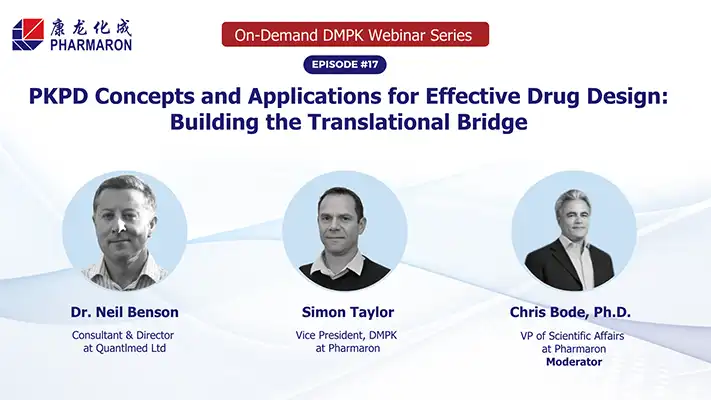
In this on-demand webinar, PK/PD experts introduce the principles behind pharmacokinetic and pharmacodynamic modelling and explain how mathematical models can connect drug exposure with efficacy, biomarkers and safety. A drug discovery case study demonstrates how preclinical efficacy and safety models were combined with human PK predictions to support clinical dose selection, therapeutic index assessment and Phase I study design.
Understanding PK/PD relationships should begin very early in a project lifecycle. A robust understanding of PK/PD is essential for clinical dose projections.

Simon Taylor
Vice President
DMPK, Pharmaron
Why does PK/PD understanding matter?
Pharmacokinetics explains what the body does to a drug, while pharmacodynamics describes what the drug does to the body. PK/PD brings these areas together to understand how drug concentration relates to the magnitude and time course of a biological response.
This relationship may not be straightforward. A pharmacodynamic effect can continue after measurable drug concentrations have declined, while biological synthesis and degradation rates may influence the onset or duration of the response. Mathematical models help scientists investigate these effects, account for variability and translate preclinical findings into more informed clinical dose and study-design decisions.
Key takeaways
- Response to a drug is more than just dose. Consider exposure, concentration, target and biology when assessing efficacy and safety.
- Pharmacodynamics isn’t dictated by the PK profile. Onset and offset of response may be controlled by biology.
- PK/PD models allow for explanatory factors. Push-pull effects, time delays, saturable/exponential processes and between-subject variability can be incorporated into PK/PD models to explain complex exposure-response relationships.
- Design experiments to best characterize the response. Meaningful pharmacodynamic information may be derived from the thoughtful selection of fewer time-points that allow for the characterization of the response over time.
- Use translational biomarkers to support pharmacological effects. Biomarkers can be used to support target engagement and help differentiate target failure from inadequate target exposure.
- Consider modelling efficacy and safety on the same dataset. Building efficacy and toxicity models concurrently can increase confidence in the predicted therapeutic window and aid in dose regimen selection.
- Initiate PK/PD interpretation early and allow it to mature with your program. Information from PK/PD can be used to make go or no-go decisions on compounds as early as testing in preclinical species.
Five questions explored in the webinar
1. What is PK/PD?
PK/PD describes the relationship between drug exposure and biological response. It connects pharmacokinetics, what the body does to a drug, with pharmacodynamics, what the drug does to the body, to explain the magnitude and time course of an effect.
2. Why might the duration of a drug effect differ from its PK half-life?
The measured response or biomarker can have its own synthesis, degradation and turnover rates. These biological processes may delay the onset of an effect or allow it to persist after the drug concentration has declined. Consequently, the PK half-life may not fully describe the pharmacologically relevant duration of action.
3. How do mathematical models support PK/PD interpretation?
PK/PD models can estimate drug concentrations between measured sampling points and relate those concentrations to pharmacodynamic observations. They can also help scientists investigate direct and delayed effects, saturable responses, biological turnover, population variability and differences between individual and average responses.
4. Why are biomarkers important to PK/PD strategy?
A pharmacological biomarker can provide evidence that a compound reached its target and produced the intended biological effect. Without this evidence, an unsuccessful clinical outcome may be difficult to interpret because scientists may not know whether the mechanism failed or whether the compound did not achieve sufficient target exposure.
5. How can PK/PD modelling support clinical dose and regimen selection?
Models can combine preclinical efficacy, biomarker and safety data with predicted human pharmacokinetics. This makes it possible to simulate different doses and dosing schedules, estimate an effective clinical dose, assess the therapeutic index and inform clinical sampling and protocol design.
What you will learn
- How PK and PD combine to describe the magnitude and duration of drug effects
- Why drug concentration and biological response may follow different time courses
- Why dose alone may not adequately describe pharmacological activity
- How free drug concentration, target engagement and biomarkers contribute to PK/PD interpretation
- How direct-effect, Emax and indirect-effect models describe different response patterns
- Why delayed responses and hysteresis can affect efficacy and safety assessment
- How population variability and data averaging can influence conclusions
- Why sampling across the time course of a response is important
- How PK/PD models can support human dose prediction and dosing-regimen selection
- How efficacy and safety models can be integrated to evaluate the therapeutic index
- How modelling outputs can contribute to Phase I protocol and sampling decisions
- Case study: Integrating efficacy, biomarkers and safety
Who should watch this webinar?
This webinar is relevant to scientists involved in:
- Drug discovery and preclinical development
- DMPK and pharmacokinetics
- Pharmacology and translational science
- PK/PD modelling and simulation
- Biomarker strategy
- Toxicology and safety assessment
- Human PK prediction
- Clinical pharmacology
- First-in-human dose selection and study design
On-demand webinar
Learn how PK/PD modelling can connect drug exposure with efficacy, biomarkers and safety, supporting more informed decisions from drug discovery through early clinical development.
