Predicting Oral Absorption with an Integrated Dissolution–Permeation System
Poster Authors:
Marta Nawrocka, Jessica Beauchamp, Sam Morris, Adam Hughes, Simon Teague, Simon Taylor
1 Pharmaron, Hoddesdon, UK
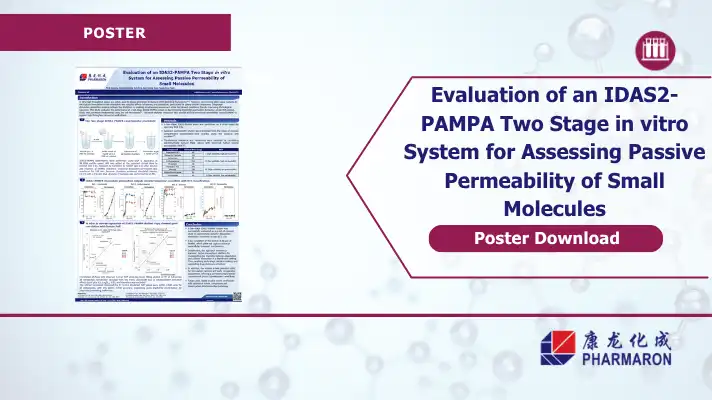
Download Poster: Evaluation of an IDAS2-PAMPA Two-Stage In Vitro System for Assessing Passive Permeability of Small Molecules
Predicting oral drug absorption for compounds with poor biopharmaceutical properties remains highly complex, mainly due to dissolution/permeability interplay. This poster presents the validation of an IDAS2-PAMPA 2-stage dissolution–permeation platform to measure passive permeability under biorelevant conditions. This platform combines dissolution and permeation measurements into one workflow to provide a pragmatic approach for studying solubility/dissolution/absorption interplay at early-stage drug discovery.
Key Takeaways:
The IDAS2-PAMPA system combines dissolution and permeability measurements in a single experiment, providing a more integrated view of factors that influence oral absorption. It successfully differentiated compounds across biopharmaceutics classification system (BCS) Classes I–IV, demonstrating its capability to identify differences in dissolution and permeation behaviour. The permeability data generated by the system showed a strong correlation with observed human intestinal permeability, supporting its potential for in vitro–in vivo extrapolation. As a cost-effective and higher-throughput approach, the platform can help researchers assess developability risks, compare compounds, and support formulation decisions earlier in the drug discovery process.
Capabilities
Conventional in vitro permeability assays give information on membrane transport but often fail to capture the impact of dissolution and solubility on oral absorption. For poorly soluble compounds, dissolution kinetics can greatly impact absorption potential. Traditional plate-based systems may therefore overlook important formulation-driven effects that determine in vivo performance.
The IDAS2-PAMPA platform consists of a 2-stage dissolution-permeation approach that integrates:
- Biorelevant gastric and intestinal dissolution conditions
- Dynamic media transitions from FaSSGF to FaSSIF
- Passive permeability assessment using PAMPALC-MS analysis for quantification of permeated compound
This approach allows the assessment of absorption behaviour under conditions that more closely reflect the gastrointestinal environment while retaining the throughput advantages required for screening applications.
Key Results
Consistent with BCS classification, the system was evaluated using nine compounds spanning BCS Classes I–IV, including:
- Propranolol
- Carbamazepine
- Atenolol
- Furosemide
The resulting dissolution and permeation profiles were consistent with expected BCS behaviour, demonstrating the model’s ability to differentiate compounds based on solubility and permeability characteristics.
There was strong correlation with human permeability:
- Correlation of experimentally derived Papp values with observed human jejunal permeability (Peff) produced:R² = 0.8 across all compounds
- Improved R² = 0.9 after excluding ketoprofen from the analysis
- Predicted Peff values within three-fold error for all compounds
- Seven of eight compounds within two-fold accuracy
These findings support the translational relevance of the system for passively permeating molecules.
The IDAS2-PAMPA system can support a range of drug discovery applications, including lead optimisation, developability assessment, biopharmaceutics risk evaluation, oral absorption prediction and early IVIVE workflows. By integrating dissolution and permeability within a single experiment, the platform provides a more complete understanding of the factors influencing oral bioavailability. Beyond permeability prediction, it can also be used to compare and rank compounds or formulations, helping to identify potential dissolution-limited absorption risks earlier in development. This cost-effective, higher-throughput approach complements conventional oral absorption assessments and supports more informed decision-making during candidate selection and formulation development.
Why Pharmaron?
Pharmaron provides comprehensive DMPK and developability solutions to support candidate selection and optimisation, including:
- Permeability and absorption studies
- Caco-2 and PAMPA assays
- Solubility and dissolution assessment
- PBPK and IVIVE modelling
- Oral bioavailability prediction
- Integrated ADME and DMPK strategies
