LNP Bioanalysis: Measuring Both the Payload and the Delivery System
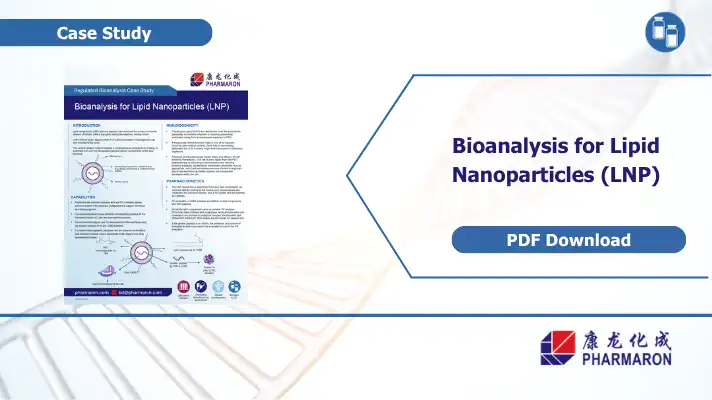
Lipid nanoparticles (LNPs) have become the preferred delivery vehicle for many nucleic acid therapies, including mRNA, siRNA, and gene-editing technologies. As their use continues to expand, so does the need for bioanalytical strategies that can fully characterize their behavior in vivo. Unlike traditional small molecules or biologics, LNPs consist of two distinct elements: the therapeutic payload and the lipid carrier. Understanding how both components distribute, persist, and perform is critical for building a complete PK and safety profile.
This case study explores the analytical considerations for LNP-based drug development, including analyte selection, immunogenicity assessment, and the technologies commonly used to support these programs. Complete the form to download the full case study.
What Makes LNP Bioanalysis Different?
Bioanalysis for LNPs extends beyond measuring the active drug. The delivery system plays a key role in performance and can influence biodistribution, clearance, safety, and efficacy. As a result, a successful analytical strategy must account for both the nucleic acid payload and relevant lipid components. Focusing only on the payload may leave significant gaps in understanding how the therapeutic behaves once administered.
Selecting the Right Analytes
A typical LNP formulation contains four primary lipid components: an ionizable lipid, phospholipids, cholesterol, and a PEGylated lipid. Together, they protect the payload and facilitate delivery to the target tissue. From a bioanalytical perspective, not every component is equally informative. The challenge is identifying which analytes are most useful for characterizing pharmacokinetics and disposition while avoiding measurements that add complexity without generating meaningful data. In some cases, the payload itself may not be the only molecule of interest. For mRNA therapeutics, measuring the expressed protein provides valuable predictive performance.
Understanding Immunogenicity Risk
Immunogenicity is another important consideration for many LNP programs.
Capabilities
- PEG containing lipids are often included in immunogenicity assessments because some individuals may already have anti-PEG antibodies from previous exposure in everyday products. These antibodies can influence both product performance and safety.
- Gene-editing therapies may introduce additional considerations. When payloads encode proteins such as Cas9 or related enzymes, pre-existing immune responses can sometimes be present because of their bacterial origins. Understanding the likelihood and potential impact of these responses is an important part of risk assessment.
The case study discusses how these immunogenicity concerns differ and when screening strategies may be appropriate.
Choosing the Right Analytical Tools
No single analytical platform can answer every question in an LNP program, leaving developers to rely on a combination of complementary technologies. Ligand binding assays are commonly used to assess immunogenicity and measure expressed proteins. LC-MS methods provide highly specific quantification of selected lipid components, while PCR-based approaches are frequently used to monitor nucleic acid payloads.
Pharmaron has supported both nonclinical and clinical LNP programs using a range of bioanalytical platforms, including anti-PEG antibody assays and immunogenicity testing for gene-editing therapies. Assay approaches are tailored to the needs of each program and developed in accordance with current regulatory expectations and industry best practices.
Key Takeaways
- Effective LNP bioanalysis requires evaluation of both the therapeutic payload and selected lipid components.
- Analyte selection is a critical part of study design, as not all lipid components provide equally valuable pharmacokinetic information.
- PEG-containing lipids and gene-editing payloads may present distinct immunogenicity considerations that should be assessed early in development.
- A comprehensive analytical strategy often combines LBA, LC-MS, and PCR technologies to generate a complete picture of product behavior.
- Pharmaron supports LNP bioanalytical programs from early development through clinical studies under GLP and GCLP-compliant environments.
What’s Included in the Case Study?
The full case study provides a detailed look at:
- How analytes are selected for LNP pharmacokinetic studies
- Which lipid components are most appropriate for monitoring and why
- Key considerations for PEG containing formulations and Cas9 based therapeutics
- When antibody screening may be warranted
- How LBA, LC-MS, and PCR platforms are applied across payload, lipid, protein, and antibody analyses
Complete the form to download the case study.

Learn more about Pharmaron’s LNP bioanalysis strategy across payload, lipid components and immunogenicity.
References
FDA. M10 Bioanalytical Method Validation and Study Sample Analysis (Guidance for Industry, Final, November 2022).
FDA. Immunogenicity Testing of Therapeutic Protein Products: Developing and Validating Assays for Anti-Drug Antibody Detection (Final, February 2019).
Chen BM, et al. Polyethylene Glycol Immunogenicity: Theoretical, Clinical, and Practical Aspects of Anti-Polyethylene Glycol Antibodies. ACS Nano. 2021;15(9):14022-14048. PMID 34469112.
Dyleski L, et al. Development of a novel anti-PEG antibody assay enabling investigation of potential immunogenicity triggered by the PEG moiety of biotherapeutics. J Immunol Methods. 2025;543:113917. PMID 40738327.