Microphysiological Systems for Human Oral Bioavailability Prediction
Poster Authors:
Barry Jones2, Lijun Gao1, Yan Zhang1, Yassen Abbas3, Jing Lai1, Morné van Wyk3, Tomasz Kostrzewski3, Chunyan Han1, and Mandy Xu1
- In vitro ADMET, Pharmaron Beijing Co., Ltd. (China)
- Pharmaron UK, Rushden, UK
- CN Bio Innovations, Ltd. Cambridge, UK
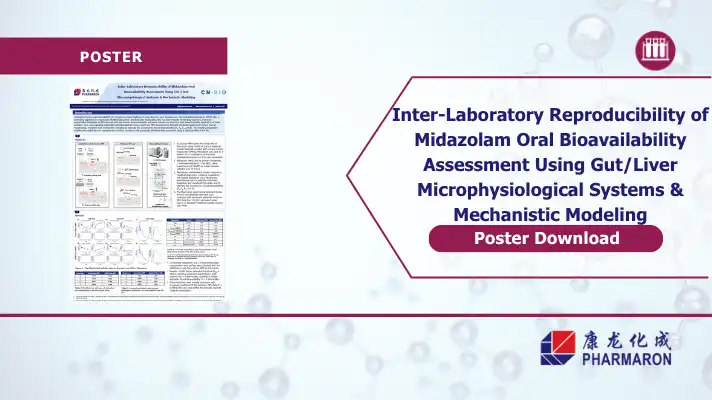
Microphysiological systems (MPS) estimate human oral bioavailability from measurements of intestinal absorption and first-pass metabolism in one integrated circuit. Those two measurements are resolved into absorbed drug and first-pass effect separately with a mechanistic model. Pharmaron has evaluated whether that estimated oral bioavailability is transferable between intestinal models and between organizations.
The poster describes the Gut/Liver MPS setup, the mechanistic modelling approach and how the model compares against independently published data.
Complete the form to the right to download.
What are microphysiological systems and why do they matter for oral bioavailability?
Microphysiological systems are fluidically integrated cell culture platforms that perfuse human tissue models under flow, allowing multiple organs to be connected in series in the same circuit. Oral bioavailability (F) is calculated from three fractions: the fraction absorbed across the gut wall (Fa), the fraction that escapes gut wall metabolism (Fg), and the fraction that survives hepatic first-pass metabolism (Fh). Coupling an intestinal model with primary human hepatocytes in a Gut/Liver MPS allows absorption and first-pass metabolism to be measured in one experiment.
Capabilities
What stops microphysiological systems data from reaching a human PK prediction?
Data acquisition is only half the battle. The concentration-time output from an MPS simply reflects events occurring within that device. Extrapolating human oral bioavailability from this requires a mechanistic model able to deconvolute intestinal absorption, intestinal metabolism and hepatic disposition (all of which are happening simultaneously in the raw profile). The success of quantitative translation will determine just how broadly these systems become implemented.
How does mechanistic modeling turn MPS data into a bioavailability estimate?
Models consisting of absorption, gut metabolism and hepatic disposition are applied and fitted to the observed concentration-time profiles of both parent drug and metabolite. By virtue of fitting the component parts rather than an overall lumped parameter, the output becomes interpretable. Pharmaron used this method with midazolam (a well-characterized CYP3A substrate) quantified along with its major metabolite using LC-MS/MS.
Why does inter-laboratory reproducibility decide whether MPS get used?
If you’ve got a platform where you’re going to get one answer running it in one location and a different answer running it somewhere else based on the operator, it’s not going to be the platform that you use to make that developmental decision. Regulators are evaluating these new approach methodologies, and the US FDA has already published organ-on-a-chip type systems as examples of human-relevant platforms they are trying to incorporate into nonclinical testing. Demonstrating that you can achieve a reproducible system that works between sites, operators and intestinal models will be what takes MPS out of the promise column.
What did Pharmaron compare?
The study ran across two intestinal models, each coupled to primary human hepatocytes. Mechanistic models were fitted to the resulting profiles to estimate the components of oral bioavailability, then set against Gut/Liver MPS data published independently by CN Bio Innovations. That makes it a cross-organization comparison rather than an internal replicate.
Key takeaways
- Coupled Gut/Liver MPS model system consisting of an intestinal absorption model linked to primary human hepatocytes.
- Used midazolam as a CYP3A probe drug to characterize intestinal absorption and first-pass metabolism.
- Applied mechanistic modeling to deconvolute the measured drug concentration-time profiles into the contributing fractions that comprise oral bioavailability instead of a single lumped parameter.
- Compared estimates to independently published Gut/Liver MPS values from another organization’s data.
- Work conducted at Pharmaron’s Beijing and UK locations, with CN Bio Innovations in Cambridge.
What is in the poster?
This poster presents the fitted model parameters, the resulting component bioavailability estimates from each intestinal model, the comparison of both to the published dataset and how both datasets compare to the clinically reported range for midazolam. Please fill out the form to download.
Frequently asked questions
What’s a microphysiological system?
A fluidically integrated cell culture platform that perfuses human tissue models, allowing multiple organ models to be linked into a single circuit while under flow.
Why couple a gut model to a liver model?
Oral bioavailability depends on intestinal absorption, gut wall metabolism and hepatic first-pass. Physiologically, they are coupled. Linking the two organ models allows a single experiment to interrogate all three.
What does mechanistic modeling add to microphysiological systems data?
Mechanistic modeling deconvolutes the measured concentration-time profiles into the constituent fractions of bioavailability. The model output is therefore a set of interpretable parameters, rather than just a curve.
Why is midazolam the model compound?
Midazolam is a well-characterized CYP3A substrate with clinically reported bioavailability. This provides a reference point against which we can judge whether a system produces a plausible answer.

Explore Pharmaron’s microphysiological systems data on midazolam oral bioavailability.
References
1. Abbas Y, et al. Drug Metab Dispos. 2025;53(9):100130. PMID 40829518.
2. Johnson TN, et al. CPT Pharmacometrics Syst Pharmacol. 2024;13(9):1570-1581. PMID 38923249.
3. FDA. New Approach Methodologies (NAMs).