Quantitative Transporter Profiling for Better IVIVE and PBPK Modelling
Poster Authors:
Chunyan Han, Jiafu Mu, Zekun Chen, Aocheng He, Yuxin Liu, Mandy Xu
1 in vitro ADMET, Pharmaron Beijing Co., Ltd. (China)
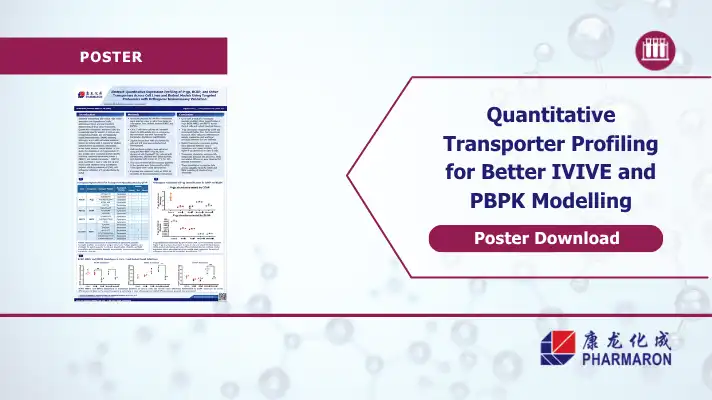
Download Poster: Quantitative Expression Profiling of P-gp, BCRP and Key Intestinal Transporters
Drug transporters are an important part of drug absorption, disposition and drug–drug interaction (DDI) risk. Being able to accurately quantify transporter expression is essential for generating reliable in vitro–in vivo extrapolation (IVIVE) and physiologically based pharmacokinetic (PBPK) models.
This poster presents a quantitative proteomics study comparing the abundance of key intestinal transporters across Caco-2 cells, rat intestine and mouse intestine, using quantitative targeted absolute proteomics (QTAP) with orthogonal validation via ELISA.
Key Takeaways:
- Quantitative measurement of key transporters, including P-glycoprotein (P-gp), Breast Cancer Resistance Protein (BCRP), Multidrug Resistance-associated Protein 2 (MRP2) and Peptide Transporter 1 (PEPT1).
- QTAP enabled robust transporter quantification with a panel of 17 surrogate peptides was used to support reliable transporter abundance measurements across multiple species and matrices.
- Species and sex comparisons; transporter abundance was generally comparable between rats and mice, while sex-related differences were observed for selected transporters.
- Supports translational modelling with quantitative transporter expression data, providing valuable inputs for IVIVE and PBPK modelling of intestinal drug absorption.
Capabilities
Why does quantitative transporter data matter? Intestinal transporters are key determinants of oral drug absorption and can significantly influence drug exposure and DDI. Despite widespread use of Caco-2 cell models and rodent tissues in transporter studies, direct quantitative comparisons across these systems remain limited. This can create uncertainty when translating preclinical findings into human predictions.
In this study, we applied quantitative targeted absolute proteomics (QTAP) to quantify transporter abundance across multiple biological systems. The approach included:
- In silico selection of transporter-specific surrogate peptides
- Membrane protein extraction and tryptic digestion
- Quantification by HPLC–Triple Quad mass spectrometry
- Orthogonal validation of P-gp abundance using ELISA
Using multiple surrogate peptides per transporter enhanced quantification reliability and ensured comprehensive transporter coverage.
Bottom Line
QTAP successfully quantified four major transporters (P-gp, BCRP, MRP2, PEPT1) across Caco-2 monolayers and rodent intestinal tissues.
In addition, the study identified clear differences between in vitro and preclinical models, with:
- Higher P-gp abundance observed in Caco-2 cells
- Distinct transporter expression patterns between Caco-2 and rodent intestine
- Comparable transporter levels between rats and mice for many proteins evaluated
Orthogonal validation supports confidence in the generated data. P-gp abundance measured using QTAP was consistently higher than values obtained by ELISA. While absolute values differed, both methods showed similar expression trends across sample types, supporting the value of combining orthogonal analytical approaches.
Quantitative transporter abundance data are increasingly being incorporated into:
- PBPK models
- IVIVE workflows
- Absorption and disposition predictions
- DDI assessments
Having a better understanding of transporter expression across commonly used experimental systems can improve model confidence and support more informed project decisions.
Why Pharmaron?
Pharmaron provides integrated transporter and DMPK solutions to support discovery and development programmes, including:
- Transporter profiling and substrate identification
- Quantitative proteomics
- IVIVE and PBPK modelling support
- Caco-2 permeability studies
- Advanced ADME and DDI assessment
- Bioanalysis and translational DMPK expertise
Our scientists combine cutting-edge analytical technologies with deep biological understanding to help generate data that are relevant, reliable and decision enabling.
