Pharmaron Shines: Scientific Excellence at SOT 2025 in Orlando
Capabilities
Toxicology and Safety Assessment at SOT
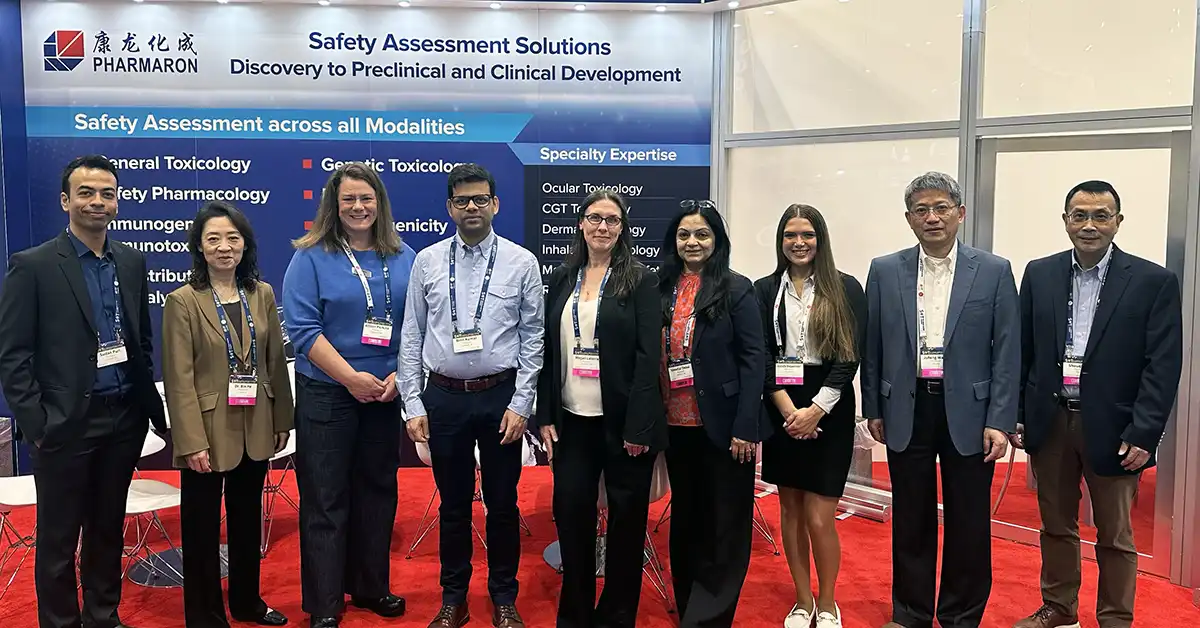
The Pharmaron team proudly wrapped up our most dynamic year at the Society of Toxicology (SOT) 2025 Annual Meeting and ToxExpo, held March 16–20 at the Orange County Convention Center in Orlando, Florida. Our team hosted several meetings throughout three exhibit days and logged over 100 attendee interactions. Our representatives discussed small molecules, biologics, CGT, and medical device development.

SOT 2025 offered the opportunity to share our research, connect with valued clients, and spotlight the comprehensive safety assessment capabilities we deliver across modalities. Our attending team included scientific leaders, scientists, and business development representatives to speak with attendees at our 10×30 booth in our private meeting space and our six scientific poster presentations.
Our exhibitor-hosted session on Monday, March 17, 2025, was well-attended. We explored hurdles in assessing novel modalities and gene therapy challenges, and our speakers addressed forward-thinking strategies to support regulatory submissions proactively. This session displayed our commitment to multispecific antibody development and gene therapies.
Pharmaron scientists presented six posters across two days, contributing new data and strategic perspectives for supporting clients through technical learnings.
You can download the posters presented below:
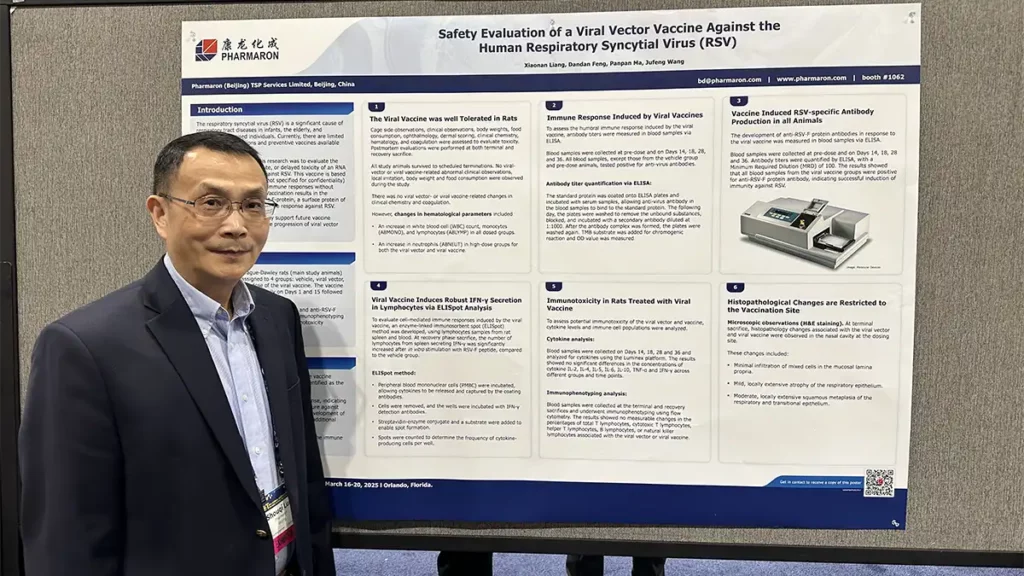
- Safety Evaluation of a Viral Vector Vaccine against the Human Respiratory Syncytial Virus (RSV)
- This poster highlights a safety study of a viral vector vaccine against RSV. The vaccine employs a live virus as a vector, resulting in the expression of the RSV F-protein and triggering a precise immune response.
- Pharmacokinetics, Efficacy, and Safety of Intramuscular and Intranasal Dexmedetomidine in Female Yucatan Pigs
- Dexmedetomidine, a sedative commonly used in veterinary research, was evaluated for its safety and effectiveness in Yucatan minipigs. This study compared intramuscular (IM) and intranasal (IN) administration with xylazine, a standard sedative.

- A Non-clinical Safety Evaluation Study of CAR-T Cells Created Through Lipid Nanoparticle-Mediated mRNA Delivery
- Chimeric antigen receptor (CAR) T cell therapy is promising for cancer treatment. However, traditional viral vector approaches for introducing the CAR gene into T cells raise concerns, including cytokine release syndrome, neurotoxicity, and permanent CAR expression. This study investigates the safety of CAR-T cells generated through mRNA-lipid nanoparticle (mRNA-LNP) delivery, a safer and more cost-effective alternative that enables temporary CAR expression with reduced toxicity.
- Nonclinical Safety Considerations for Multispecific Antibodies
- Multispecific antibodies show promise in tumor immunotherapy due to their increased specificity and reduced off-target toxicity. This poster shows a four-week study with cynomolgus monkeys to evaluate MsAb-1, an antibody targeting cell cycle proteins and a tumor-associated antigen (TAA) to enhance T-cell activation and targeting.
- Establishment of a One-Step RT-qPCR Method to Investigate the Biodistribution of a Virus-based Vector Vaccine
- This study describes the method validation of a one-step RT-qPCR to investigate the biodistribution of a viral vector vaccine against RSV in rats after nasal administration. Tissues from key organ systems and blood were collected for analysis. RNA extraction was performed using the Kingfisher Apex, followed by RT-qPCR analysis on the QuantStudio system. Method qualification confirmed robust accuracy, precision, and stability.
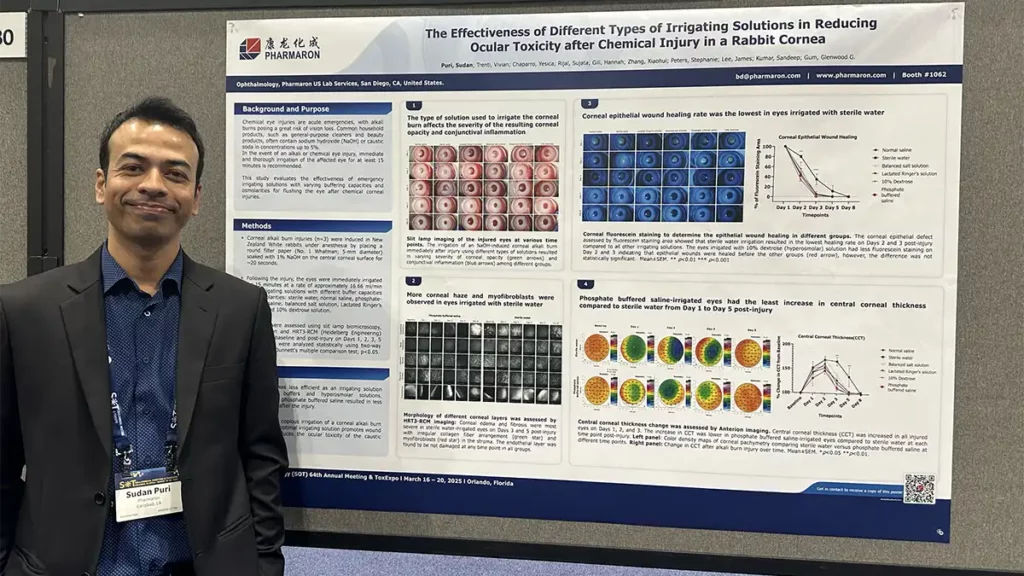
- The Effectiveness of Different Irrigating Solutions in Reducing Ocular Toxicity after Chemical Injury in Rabbit Corneas
- Corneal injuries from chemicals can cause severe vision impairment, underscoring the need for optimized treatment strategies to reduce the toxicity of the injury-causing chemical. This research focuses on developing effective eye injury treatments by evaluating various irrigating solutions in a corneal wound healing model.
These presentations showcased our integrated capabilities across discovery and regulatory toxicology, drug metabolism and pharmacokinetics (DMPK), and complex biotherapeutics. They also fostered direct engagement with attendees interested in advancing their studies with the support of an experienced and collaborative CRO.
We are already looking forward to SOT 2026 in San Diego. Thank you to everyone who visited our booth, attended our session, engaged with our scientists, or stopped by to learn more. Pharmaron remains driven by science to help our partners succeed, and events like SOT give us the platform to prove it.
Stay tuned for upcoming publications, webinar announcements, and poster re-releases as we continue promoting insights from SOT 2025.